


Page 37 - Read Online
P. 37
Wang et al. Soft Sci 2023;3:34  https://dx.doi.org/10.20517/ss.2023.25           Page 5 of 26


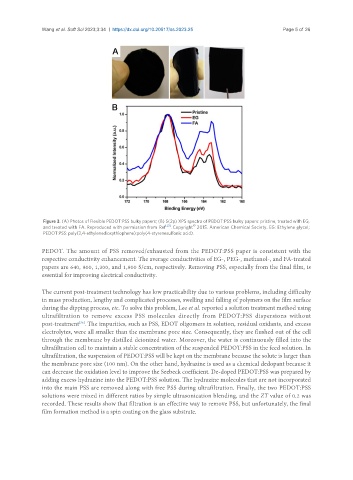
                Figure 3. (A) Photos of Flexible PEDOT:PSS bulky papers; (B) S(2p) XPS spectra of PEDOT:PSS bulky papers: pristine, treated with EG,
                                                                  ©
                and treated with FA. Reproduced with permission from  Ref [23] . Copyright  2015. American Chemical Society. EG: Ethylene glycol;
                PEDOT:PSS: poly(3,4-ethylenedioxythiophene):poly(4-styrenesulfonic acid).

               PEDOT. The amount of PSS removed/exhausted from the PEDOT:PSS paper is consistent with the
               respective conductivity enhancement. The average conductivities of EG-, PEG-, methanol-, and FA-treated
               papers are 640, 800, 1,300, and 1,900 S/cm, respectively. Removing PSS, especially from the final film, is
               essential for improving electrical conductivity.


               The current post-treatment technology has low practicability due to various problems, including difficulty
               in mass production, lengthy and complicated processes, swelling and falling of polymers on the film surface
               during the dipping process, etc. To solve this problem, Lee et al. reported a solution treatment method using
               ultrafiltration  to  remove  excess  PSS  molecules  directly  from  PEDOT:PSS  dispersions  without
               post-treatment . The impurities, such as PSS, EDOT oligomers in solution, residual oxidants, and excess
                            [35]
               electrolytes, were all smaller than the membrane pore size. Consequently, they are flushed out of the cell
               through the membrane by distilled deionized water. Moreover, the water is continuously filled into the
               ultrafiltration cell to maintain a stable concentration of the suspended PEDOT:PSS in the feed solution. In
               ultrafiltration, the suspension of PEDOT:PSS will be kept on the membrane because the solute is larger than
               the membrane pore size (100 nm). On the other hand, hydrazine is used as a chemical dedopant because it
               can decrease the oxidation level to improve the Seebeck coefficient. De-doped PEDOT:PSS was prepared by
               adding excess hydrazine into the PEDOT:PSS solution. The hydrazine molecules that are not incorporated
               into the main PSS are removed along with free PSS during ultrafiltration. Finally, the two PEDOT:PSS
               solutions were mixed in different ratios by simple ultrasonication blending, and the ZT value of 0.2 was
               recorded. These results show that filtration is an effective way to remove PSS, but unfortunately, the final
               film formation method is a spin coating on the glass substrate.

