


Page 36 - Read Online
P. 36
Page 4 of 26                            Wang et al. Soft Sci 2023;3:34  https://dx.doi.org/10.20517/ss.2023.25


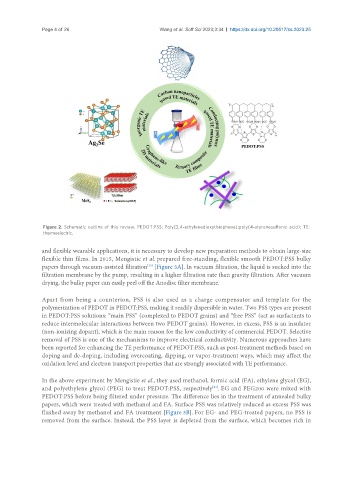
                Figure 2. Schematic outline of this review. PEDOT:PSS: Poly(3,4-ethylenedioxythiophene):poly(4-styrenesulfonic acid); TE:
                thermoelectric.

               and flexible wearable applications, it is necessary to develop new preparation methods to obtain large-size
               flexible thin films. In 2015, Mengistie et al. prepared free-standing, flexible smooth PEDOT:PSS bulky
               papers through vacuum-assisted filtration  [Figure 3A]. In vacuum filtration, the liquid is sucked into the
                                                   [23]
               filtration membrane by the pump, resulting in a higher filtration rate than gravity filtration. After vacuum
               drying, the bulky paper can easily peel off the Anodisc filter membrane.

               Apart from being a counterion, PSS is also used as a charge compensator and template for the
               polymerization of PEDOT in PEDOT:PSS, making it readily dispersible in water. Two PSS types are present
               in PEDOT:PSS solutions: “main PSS” (complexed to PEDOT grains) and “free PSS” (act as surfactants to
               reduce intermolecular interactions between two PEDOT grains). However, in excess, PSS is an insulator
               (non-ionizing dopant), which is the main reason for the low conductivity of commercial PEDOT. Selective
               removal of PSS is one of the mechanisms to improve electrical conductivity. Numerous approaches have
               been reported for enhancing the TE performance of PEDOT:PSS, such as post-treatment methods based on
               doping and de-doping, including overcoating, dipping, or vapor-treatment ways, which may affect the
               oxidation level and electron transport properties that are strongly associated with TE performance.

               In the above experiment by Mengistie et al., they used methanol, formic acid (FA), ethylene glycol (EG),
               and polyethylene glycol (PEG) to treat PEDOT:PSS, respectively . EG and PEG200 were mixed with
                                                                         [23]
               PEDOT:PSS before being filtered under pressure. The difference lies in the treatment of annealed bulky
               papers, which were treated with methanol and FA. Surface PSS was relatively reduced as excess PSS was
               flushed away by methanol and FA treatment [Figure 3B]. For EG- and PEG-treated papers, no PSS is
               removed from the surface. Instead, the PSS layer is depleted from the surface, which becomes rich in

