


Page 57 - Read Online
P. 57
Wei et al. Soft Sci 2023;3:17  https://dx.doi.org/10.20517/ss.2023.09           Page 29 of 38


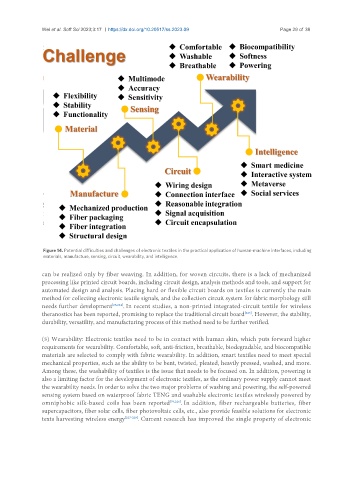
                Figure 14. Potential difficulties and challenges of electronic textiles in the practical application of human-machine interfaces, including
                materials, manufacture, sensing, circuit, wearability, and intelligence.

               can be realized only by fiber weaving. In addition, for woven circuits, there is a lack of mechanized
               processing like printed circuit boards, including circuit design, analysis methods and tools, and support for
               automated design and analysis. Placing hard or flexible circuit boards on textiles is currently the main
               method for collecting electronic textile signals, and the collection circuit system for fabric morphology still
               needs further development [28,224] . In recent studies, a non-printed integrated-circuit textile for wireless
               theranostics has been reported, promising to replace the traditional circuit board . However, the stability,
                                                                                   [225]
               durability, versatility, and manufacturing process of this method need to be further verified.

               (5) Wearability: Electronic textiles need to be in contact with human skin, which puts forward higher
               requirements for wearability. Comfortable, soft, anti-friction, breathable, biodegradable, and biocompatible
               materials are selected to comply with fabric wearability. In addition, smart textiles need to meet special
               mechanical properties, such as the ability to be bent, twisted, pleated, heavily pressed, washed, and more.
               Among these, the washability of textiles is the issue that needs to be focused on. In addition, powering is
               also a limiting factor for the development of electronic textiles, as the ordinary power supply cannot meet
               the wearability needs. In order to solve the two major problems of washing and powering, the self-powered
               sensing system based on waterproof fabric TENG and washable electronic textiles wirelessly powered by
               omniphobic silk-based coils has been reported [79,226] . In addition, fiber rechargeable batteries, fiber
               supercapacitors, fiber solar cells, fiber photovoltaic cells, etc., also provide feasible solutions for electronic
               texts harvesting wireless energy [227-229] . Current research has improved the single property of electronic

