


Page 84 - Read Online
P. 84
Zhao et al. Soft Sci 2024;4:18  https://dx.doi.org/10.20517/ss.2024.04          Page 19 of 32

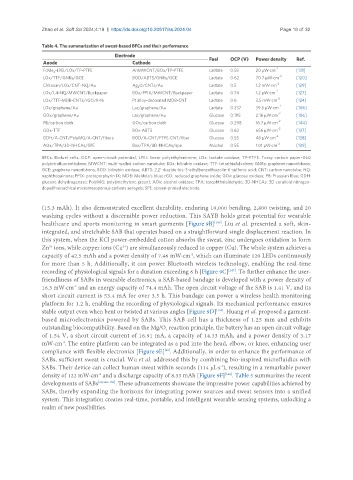
               Table 4. The summarization of sweat-based BFCs and their performance
                                        Electrode
                Anode                         Cathode                   Fuel   OCP (V)  Power density  Ref.
                FcMe -LPEI/LOx/TP-PTFE        AnMWCNT/BOx/TP-PTFE       Lactate  0.55  20 μW·cm -2   [131]
                   2
                                                                                               -2
                LOx/TTF/GNRs/GCE              BOD/ABTS/GNRs/GCE         Lactate  0.62  70.7 µW·cm    [120]
                                                                                              -2
                Chitosan/LOx/CNT-NQ/Au        Ag O/CNTs/Au              Lactate  0.5   1.2 mW·cm     [129]
                                               2
                LOx/1,4-NQ/MWCNT/Buckpaper    BOx/PPIX/MWCNT/Buckpaper  Lactate  0.74  1.2 μW·cm -2  [127]
                                                                                               -2
                LOx/TTF-MDB-CNTs/rGO/h-Ni     Pt alloy-decorated MDB-CNT  Lactate  0.6  3.5 mW·cm    [124]
                LOx/graphene/Au               Lac/graphene/Au           Lactate  0.337  39.5 μW·cm -2  [106]
                                                                                               -2
                GOx/graphene/Au               Lac/graphene/Au           Glucose  0.195  2.16 μW·cm   [106]
                                                                                               -2
                PB/carbon cloth               GOx/carbon cloth          Glucose  0.298  16.7 μW·cm   [144]
                GOx-TTF                       BOx-ABTS                  Glucose  0.62  656 μW·cm -2  [137]
                                                                                              -2
                GDH/A-CNT/PolyMG/A-CNT/fibers  BOD/A-CNT/PTFE-CNT/fiber  Glucose  0.55  48 μW·cm     [138]
                                                                                              -2
                AOx/TPA/3D-NHCAs/SPE          Box/TPA/3D-NHCAs/spe      Alcohol  0.55  1.01 μW·cm    [139]
               BFCs: Biofuel cells; OCP: open-circuit potential; LPEI: linear polyethylenimine; LOx: lactate oxidase; TP-PTFE: Toray carbon paper-060
               polytetrafluoroethylene; MWCNT: multi-walled carbon nanotube; BOx: bilirubin oxidase; TTF: tetrathiafulvalene; GNRs: graphene nanoribbons;
               GCE: graphene nanoribbons; BOD: bilirubin oxidase; ABTS: 2,2’-diazide-bis-3-ethylbenzothiazolin-6-sulfonic acid; CNT: carbon nanotube; NQ:
               naphthoquinone; PPIX: protoporphyrin IX; MDB: Meldola’s blue; rGO: reduced graphene oxide; GOx: glucose oxidase; PB: Prussian Blue; GDH:
               glucose dehydrogenase; PolyMG: poly(methylene green); AOx: alcohol oxidase; TPA: terephthalaldehyde; 3D-NHCAs: 3D coralloid nitrogen-
               doped hierarchical micromesoporous carbons aerogels; SPE: screen-printed electrode.


               (15.3 mAh). It also demonstrated excellent durability, enduring 10,000 bending, 2,800 twisting, and 20
               washing cycles without a discernible power reduction. This SAYB holds great potential for wearable
               healthcare and sports monitoring in smart garments [Figure 9B] . Liu et al. presented a soft, skin-
                                                                         [146]
               integrated, and stretchable SAB that operates based on a straightforward single displacement reaction. In
               this system, when the KCl power-embedded cotton absorbs the sweat, zinc undergoes oxidation to form
               Zn  ions, while copper ions (Cu ) are simultaneously reduced to copper (Cu). The whole system achieves a
                                          2+
                  2+
                                                                 -2
               capacity of 42.5 mAh and a power density of 7.46 mW·cm , which can illuminate 120 LEDs continuously
               for more than 5 h. Additionally, it can power Bluetooth wireless technology, enabling the real-time
                                                                              [147]
               recording of physiological signals for a duration exceeding 6 h [Figure 9C] . To further enhance the user-
               friendliness of SABs in wearable electronics, a SAB-based bandage is developed with a power density of
                          -2
               16.3 mW·cm  and an energy capacity of 74.4 mAh. The open circuit voltage of the SAB is 1.41 V, and its
               short circuit current is 53.4 mA for over 3.5 h. This bandage can power a wireless health monitoring
               platform for 1.2 h, enabling the recording of physiological signals. Its mechanical performance ensures
               stable output even when bent or twisted at various angles [Figure 9D] . Huang et al. proposed a garment-
                                                                          [148]
               based microelectronics powered by SABs. This SAB cell has a thickness of 1.25 mm and exhibits
               outstanding biocompatibility. Based on the Mg/O  reaction principle, the battery has an open circuit voltage
                                                         2
               of 1.54 V, a short circuit current of 16.91 mA, a capacity of 14.33 mAh, and a power density of 3.17
               mW·cm . The entire platform can be integrated as a pad into the head, elbow, or knee, enhancing user
                      -2
               compliance with flexible electronics [Figure 9E] . Additionally, in order to enhance the performance of
                                                        [69]
               SABs, sufficient sweat is crucial. Wu et al. addressed this by combining bio-inspired microfluidics with
               SABs. Their device can collect human sweat within seconds (114 μL·s ), resulting in a remarkable power
                                                                           -1
               density of 122 mW·cm  and a discharge capacity of 8.33 mAh [Figure 9F] . Table 5 summarizes the recent
                                  -2
                                                                             [149]
               developments of SABs [69,146-152] . These advancements showcase the impressive power capabilities achieved by
               SABs, thereby expanding the horizons for integrating power sources and sweat sensors into a unified
               system. This integration creates real-time, portable, and intelligent wearable sensing systems, unlocking a
               realm of new possibilities.

