


Page 87 - Read Online
P. 87
Page 22 of 32                           Zhao et al. Soft Sci 2024;4:18  https://dx.doi.org/10.20517/ss.2024.04


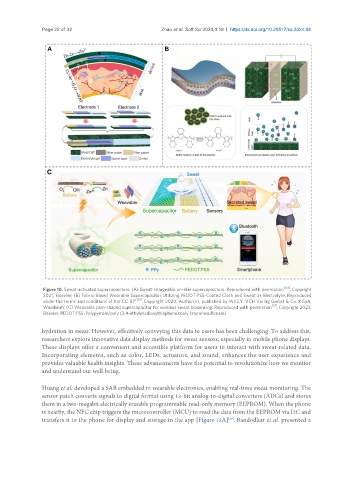
                Figure 10. Sweat-activated supercapacitors. (A) Sweat-chargeable on-skin supercapacitors. Reproduced with permission [153] . Copyright
                2021, Elsevier; (B) Fabric-Based Wearable Supercapacitor Utilizing PEDOT:PSS-Coated Cloth and Sweat as Electrolyte. Reproduced
                under the terms and conditions of the CC  BY [154] . Copyright 2020, Author(s), published by WILEY VCH Verlag GmbH & Co. KGaA,
                Weinheim; (C) Weavable yarn-shaped supercapacitor for wireless sweat biosensing. Reproduced with permission [37] . Copyright 2023,
                Elsevier. PEDOT:PSS: Polypyrrole/poly (3,4-ethylenedioxythiophene):poly (styrenesulfonate).

               hydration in sweat. However, effectively conveying this data to users has been challenging. To address this,
               researchers explore innovative data display methods for sweat sensors, especially in mobile phone displays.
               These displays offer a convenient and accessible platform for users to interact with sweat-related data.
               Incorporating elements, such as color, LEDs, actuators, and sound, enhances the user experience and
               provides valuable health insights. These advancements have the potential to revolutionize how we monitor
               and understand our well-being.


               Huang et al. developed a SAB embedded in wearable electronics, enabling real-time sweat monitoring. The
               sensor patch converts signals to digital format using 12-bit analog-to-digital converters (ADCs) and stores
               them in a two-megabit electrically erasable programmable read-only memory (EEPROM). When the phone
               is nearby, the NFC chip triggers the microcontroller (MCU) to read the data from the EEPROM via I2C and
               transfers it to the phone for display and storage in the app [Figure 12A] . Bandodkar et al. presented a
                                                                              [69]

