


Page 88 - Read Online
P. 88
Zhao et al. Soft Sci 2024;4:18  https://dx.doi.org/10.20517/ss.2024.04          Page 23 of 32


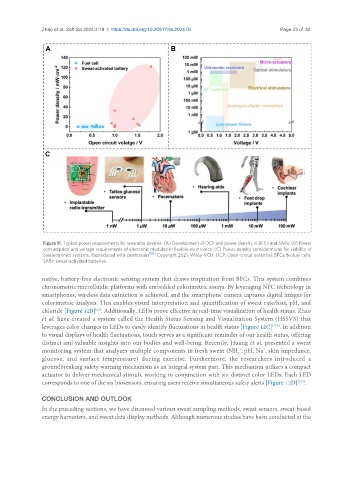
                Figure 11. Typical power requirements for wearable devices. (A) Development of OCP and power density in BFCs and SABs; (B) Power
                consumption and voltage requirements of electronic modules in flexible electronics; (C) Power density considerations for viability of
                bioelectronics systems. Reproduced with permission [155] . Copyright 2021, Wiley-VCH. OCP: Open-circuit potential; BFCs: biofuel cells;
                SABs: sweat-activated batteries.


               native, battery-free electronic sensing system that draws inspiration from BFCs. This system combines
               chronometric microfluidic platforms with embedded colorimetric assays. By leveraging NFC technology in
               smartphones, wireless data extraction is achieved, and the smartphone camera captures digital images for
               colorimetric analysis. This enables visual interpretation and quantification of sweat rate/loss, pH, and
               chloride [Figure 12B] . Additionally, LEDs prove effective in real-time visualization of health status. Zhao
                                 [60]
               et al. have created a system called the Health Status Sensing and Visualization System (HSSVS) that
                                                                                             [150]
               leverages color changes in LEDs to easily identify fluctuations in health status [Figure 12C] . In addition
               to visual displays of health fluctuations, touch serves as a significant reminder of our health status, offering
               distinct and valuable insights into our bodies and well-being. Recently, Huang et al. presented a sweat
                                                                                          +
               monitoring system that analyzes multiple components in fresh sweat (NH , pH, Na , skin impedance,
                                                                                  +
                                                                                 4
               glucose,  and  surface  temperature)  during  exercise.  Furthermore,  the  researchers  introduced  a
               groundbreaking safety warning mechanism as an integral system part. This mechanism utilizes a compact
               actuator to deliver mechanical stimuli, working in conjunction with six distinct color LEDs. Each LED
               corresponds to one of the six biosensors, ensuring users receive simultaneous safety alerts [Figure 12D] .
                                                                                                     [159]
               CONCLUSION AND OUTLOOK
               In the preceding sections, we have discussed various sweat sampling methods, sweat sensors, sweat-based
               energy harvesters, and sweat data display methods. Although numerous studies have been conducted at the

