


Page 83 - Read Online
P. 83
Page 18 of 32                           Zhao et al. Soft Sci 2024;4:18  https://dx.doi.org/10.20517/ss.2024.04

               human sweat.


               Microbial fuel cells (MFC) have recently become a promising method for harnessing energy from human
               sweat. This innovative approach involves utilizing bacteria as biocatalysts to effectively convert the chemical
                                                                                         [140]
               energy present in sweat into electrical power through bacterial metabolism [Figure 8F] . Mohammadifar
               et al. developed a flexible MFC that generates electricity from sweat using selected bacteria. The MFC can
               utilize either ammonia-oxidizing or common skin bacteria, offering long-term stability and self-sustaining
               features. The MFCs contain microorganisms with inherent abilities for self-assembly, self-repair, and self-
               maintenance. When triggered by human perspiration, the MFC achieved the highest power density of 41.74
               ± 5.35 μW·cm  with freeze-dried S. epidermidis [Figure 8G] . The utilization of microbial energy for
                                                                    [141]
                           -2
               wearable electronics remains relatively unexplored, primarily due to concerns regarding the potential
               toxicity associated with microbial cells. The biocompatibility of these approaches requires further validation.
               Non-enzymatic fuel cells have also emerged as a promising alternative, offering potential for long-term
               operation  in  sweat-based  platforms [142,143] . Table 4  summarizes  the  recent  developments  of
               BFCs [106,120,124,127,129,131,137-139,144] . All these developments underscore their potential in energy generation, with
               advantages including their renewable fuel sources, miniaturization potential, flexibility, and potential for
               integration into compact devices, enabling them to provide sufficient, sustainable, and biocompatible power
               for wearable electronics.

               Sweat-activated battery
               Batteries are essential for providing continuous power to flexible electronic devices owing to their high
               energy density, low self-discharge, and constant voltage output. Nevertheless, conventional batteries pose
               safety risks in wearable electronics due to the presence of toxic components (such as lead, cobalt, nickel, and
               so on) and flammable electrolytes. Rigid format is also a big hurdle when utilizing in flexible electronics.
               Therefore, plenty of power sources such as SABs, piezoelectric nanogenerators, TENGs, and flexible lithium
               batteries have been extensively explored to power the flexible electronics. Among these methods, SABs are a
               promising power source for wearable electronics due to their flexibility, biocompatibility, ease of use, and
               other merits.


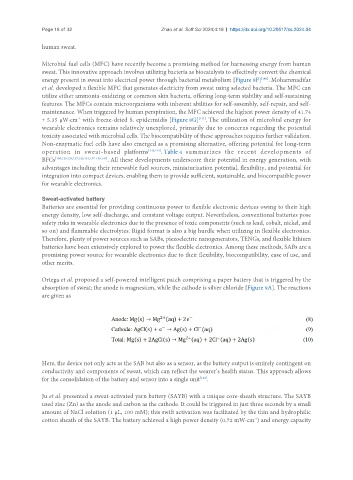
               Ortega et al. proposed a self-powered intelligent patch comprising a paper battery that is triggered by the
               absorption of sweat; the anode is magnesium, while the cathode is silver chloride [Figure 9A]. The reactions
               are given as


               Here, the device not only acts as the SAB but also as a sensor, as the battery output is entirely contingent on
               conductivity and components of sweat, which can reflect the wearer’s health status. This approach allows
                                                                    [145]
               for the consolidation of the battery and sensor into a single unit .
               Ju et al. presented a sweat-activated yarn battery (SAYB) with a unique core-sheath structure. The SAYB
               used zinc (Zn) as the anode and carbon as the cathode. It could be triggered in just three seconds by a small
               amount of NaCl solution (1 μL, 100 mM); this swift activation was facilitated by the thin and hydrophilic
               cotton sheath of the SAYB. The battery achieved a high power density (0.72 mW·cm ) and energy capacity
                                                                                       -2

