


Page 76 - Read Online
P. 76
Zhao et al. Soft Sci 2024;4:18  https://dx.doi.org/10.20517/ss.2024.04          Page 11 of 32


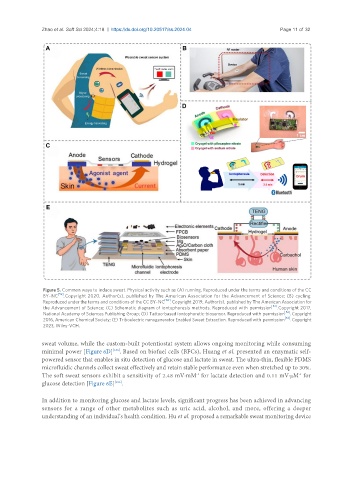
                Figure 5. Common ways to induce sweat. Physical activity such as (A) running. Reproduced under the terms and conditions of the CC
                BY-NC [59] . Copyright 2020, Author(s), published by The American Association for the Advancement of Science; (B) cycling.
                Reproduced under the terms and conditions of the CC BY-NC [60] . Copyright 2019, Author(s), published by The American Association for
                the Advancement of Science; (C) Schematic diagram of iontophoresis methods. Reproduced with  permission [61] . Copyright 2017,
                National Academy of Sciences Publishing Group; (D) Tattoo-based iontophoretic-biosensor. Reproduced with permission [62] . Copyright
                2016, American Chemical Society; (E) Triboelectric nanogenerator Enabled Sweat Extraction. Reproduced with permission [63] . Copyright
                2023, Wiley-VCH.


               sweat volume, while the custom-built potentiostat system allows ongoing monitoring while consuming
               minimal power [Figure 6D] . Based on biofuel cells (BFCs), Huang et al. presented an enzymatic self-
                                       [105]
               powered sensor that enables in situ detection of glucose and lactate in sweat. The ultra-thin, flexible PDMS
               microfluidic channels collect sweat effectively and retain stable performance even when stretched up to 30%.
               The soft sweat sensors exhibit a sensitivity of 2.48 mV·mM  for lactate detection and 0.11 mV·μM  for
                                                                   -1
                                                                                                      -1
                                        [106]
               glucose detection [Figure 6E] .
               In addition to monitoring glucose and lactate levels, significant progress has been achieved in advancing
               sensors for a range of other metabolites such as uric acid, alcohol, and more, offering a deeper
               understanding of an individual’s health condition. Hu et al. proposed a remarkable sweat monitoring device

