


Page 75 - Read Online
P. 75
Page 10 of 32                           Zhao et al. Soft Sci 2024;4:18  https://dx.doi.org/10.20517/ss.2024.04

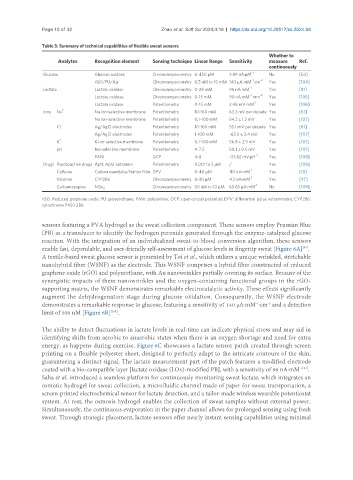
               Table 3. Summary of technical capabilities of flexible sweat sensors
                                                                                            Whether to
                     Analytes    Recognition element  Sensing technique Linear Range  Sensitivity  measure   Ref.
                                                                                            continuously
                Glucose          Glucose oxidase    Chronoamperometry 0-450 μM  2.89 nA·μM -1  No     [54]
                                                                                      -1  -2
                                 rGO/PU/Au          Chronoamperometry 0.5 nM to 10 mM 140 μA·mM ·cm  Yes  [104]
                                                                                     -1
                Lactate          Lactate oxidase    Chronoamperometry 0-28 mM  96 nA·mM     Yes       [81]
                                                                                     -1
                                 Lactate oxidase    Chronoamperometry 0-15 mM  90 nA·mM ·mm -2  Yes   [105]
                                                                                       -1
                                 Lactate oxidase    Potentiometry  0-15 mM    2.48 mV·mM    Yes       [106]
                Ions  Na +       Na Ion-selective membrane  Potentiometry  10-160 mM  63.2 mV per decade Yes  [61]
                                 Na Ion-selective membrane  Potentiometry  0.1-100 mM  54.2 ± 1.3 mV  Yes  [107]
                    Cl -         Ag/AgCl electrodes  Potentiometry  10-160 mM  55.1 mV per decade Yes  [61]
                                 Ag/AgCl electrodes  Potentiometry  1-100 mM  -63.0 ± 2.4 mV  Yes     [107]
                     +
                    K            K Ion-selective membrane  Potentiometry  0.1-100 mM  56.8 ± 2.5 mV  Yes  [107]
                    pH           Ion-selective membrane  Potentiometry  4-7.5  50.1 ± 0.5 mV  Yes     [107]
                                                                                       -1
                                 PANI               OCP            4-8        -33.82 mV·pH  Yes       [108]
                Drugs  Psychoactive drugs Apt1, Apt2 aptamers  Potentiometry  0.001 to 5 μM  /  Yes   [108]
                    Caffeine     Carbon nanotube/Nafion Film DPV   0-40 μM    110 nA·mM -1  Yes       [18]
                                                                                     -1
                    Nicotine     CYP2B6             Chronoamperometry 0-30 μM  4.3 nA·mM    Yes       [97]
                                                                                       -1
                    Carbamazepine  NiSe 2           Chronoamperometry 50 nM to 10 μM  65.65 μA·mM  No  [109]
               rGO: Reduced graphene oxide; PU: polyurethane; PANI: polyaniline; OCP: open-circuit potential; DPV: differential pulse voltammetry; CYP2B6:
               cytochrome P450 2B6.

               sensors featuring a PVA hydrogel as the sweat collection component. These sensors employ Prussian Blue
               (PB) as a transducer to identify the hydrogen peroxide generated through the enzyme-catalyzed glucose
               reaction. With the integration of an individualized sweat-to-blood conversion algorithm, these sensors
               enable fast, dependable, and user-friendly self-assessment of glucose levels in fingertip sweat [Figure 6A] .
                                                                                                       [54]
               A textile-based sweat glucose sensor is presented by Toi et al., which utilizes a unique wrinkled, stretchable
               nanohybrid fiber (WSNF) as the electrode. This WSNF comprises a hybrid fiber constructed of reduced
               graphene oxide (rGO) and polyurethane, with Au nanowrinkles partially covering its surface. Because of the
               synergistic impacts of these nanowrinkles and the oxygen-containing functional groups in the rGO-
               supporting matrix, the WSNF demonstrates remarkable electrocatalytic activity. These effects significantly
               augment the dehydrogenation stage during glucose oxidation. Consequently, the WSNF electrode
               demonstrates a remarkable response to glucose, featuring a sensitivity of 140 μA·mM ·cm  and a detection
                                                                                           -2
                                                                                       -1
                                      [104]
               limit of 500 nM [Figure 6B] .
               The ability to detect fluctuations in lactate levels in real-time can indicate physical stress and may aid in
               identifying shifts from aerobic to anaerobic states when there is an oxygen shortage and need for extra
               energy, as happens during exercise. Figure 6C showcases a lactate sensor patch created through screen
               printing on a flexible polyester sheet, designed to perfectly adapt to the intricate contours of the skin,
               guaranteeing a distinct signal. The lactate measurement part of the patch features a modified electrode
               coated with a bio-compatible layer [lactate oxidase (LOx)-modified PB], with a sensitivity of 96 nA·mM -1[81] .
               Saha et al. introduced a seamless platform for continuously monitoring sweat lactate, which integrates an
               osmotic hydrogel for sweat collection, a microfluidic channel made of paper for sweat transportation, a
               screen-printed electrochemical sensor for lactate detection, and a tailor-made wireless wearable potentiostat
               system. At rest, the osmosis hydrogel enables the collection of sweat samples without external power.
               Simultaneously, the continuous evaporation in the paper channel allows for prolonged sensing using fresh
               sweat. Through strategic placement, lactate sensors offer nearly instant sensing capabilities using minimal

