


Page 70 - Read Online
P. 70
Zhao et al. Soft Sci 2024;4:18  https://dx.doi.org/10.20517/ss.2024.04           Page 5 of 32


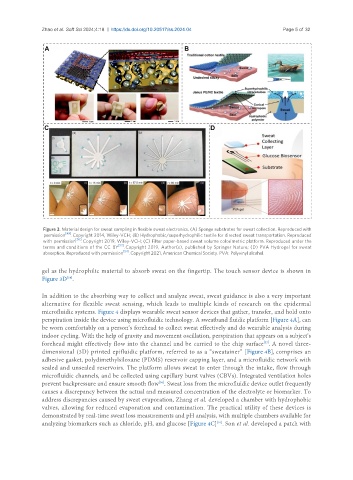
                Figure 3. Material design for sweat sampling in flexible sweat electronics. (A) Sponge substrates for sweat collection. Reproduced with
                permission [49] . Copyright 2014, Wiley-VCH; (B) Hydrophobic/superhydrophilic textile for directed sweat transportation. Reproduced
                with  permission [50] . Copyright 2019, Wiley-VCH; (C) Filter paper-based sweat volume colorimetric platform. Reproduced under the
                terms and conditions of the CC  BY [52] . Copyright 2019, Author(s), published by Springer Nature; (D) PVA Hydrogel for sweat
                absorption. Reproduced with permission [54] . Copyright 2021, American Chemical Society. PVA: Polyvinyl alcohol.

               gel as the hydrophilic material to absorb sweat on the fingertip. The touch sensor device is shown in
                        [54]
               Figure 3D .
               In addition to the absorbing way to collect and analyze sweat, sweat guidance is also a very important
               alternative for flexible sweat sensing, which leads to multiple kinds of research on the epidermal
               microfluidic systems. Figure 4 displays wearable sweat sensor devices that gather, transfer, and hold onto
               perspiration inside the device using microfluidic technology. A sweatband fluidic platform [Figure 4A], can
               be worn comfortably on a person’s forehead to collect sweat effectively and do wearable analysis during
               indoor cycling. With the help of gravity and movement oscillation, perspiration that appears on a subject’s
               forehead might effectively flow into the channel and be carried to the chip surface . A novel three-
                                                                                          [55]
               dimensional (3D) printed epifluidic platform, referred to as a “sweatainer” [Figure 4B], comprises an
               adhesive gasket, polydimethylsiloxane (PDMS) reservoir capping layer, and a microfluidic network with
               sealed and unsealed reservoirs. The platform allows sweat to enter through the intake, flow through
               microfluidic channels, and be collected using capillary burst valves (CBVs). Integrated ventilation holes
               prevent backpressure and ensure smooth flow . Sweat loss from the microfluidic device outlet frequently
                                                       [56]
               causes a discrepancy between the actual and measured concentration of the electrolyte or biomarker. To
               address discrepancies caused by sweat evaporation, Zhang et al. developed a chamber with hydrophobic
               valves, allowing for reduced evaporation and contamination. The practical utility of these devices is
               demonstrated by real-time sweat loss measurements and pH analysis, with multiple chambers available for
               analyzing biomarkers such as chloride, pH, and glucose [Figure 4C] . Son et al. developed a patch with
                                                                          [57]

