


Page 37 - Read Online
P. 37
Page 8 of 23                             Yun et al. Soft Sci 2023;3:12  https://dx.doi.org/10.20517/ss.2023.04


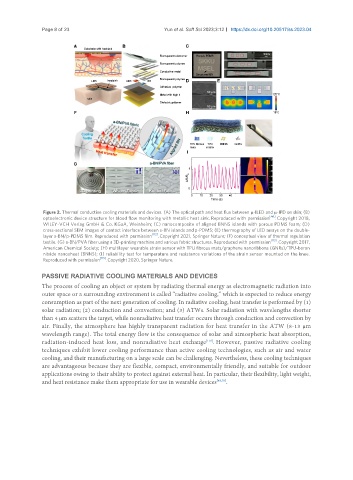
                Figure 2. Thermal conductive cooling materials and devices. (A) The optical path and heat flux between µ-ILED and µ-IPD on skin; (B)
                optoelectronic device structure for blood flow monitoring with metallic heat sink. Reproduced with  permission [46] . Copyright 2018,
                WILEY-VCH Verlag GmbH & Co. KGaA, Weinheim; (C) nanocomposite of aligned BNNS islands with porous PDMS foam; (D)
                cross-sectional SEM images of contact interface between s-BN islands and p-PDMS; (E) thermography of LED arrays on the double-
                layer s-BN/p-PDMS film. Reproduced with permission [112] . Copyright 2021, Springer Nature; (F) conceptual view of thermal regulation
                textile. (G) a-BN/PVA fiber using a 3D-printing machine and various fabric structures. Reproduced with permission [113] . Copyright 2017,
                American Chemical Society; (H) multilayer wearable strain sensor with TPU fibrous mats/graphene nanoribbons (GNRs)/TPU-boron
                nitride nanosheet (BNNS); (I) reliability test for temperature and resistance variations of the strain sensor mounted on the knee.
                Reproduced with permission [115] . Copyright 2020, Springer Nature.


               PASSIVE RADIATIVE COOLING MATERIALS AND DEVICES
               The process of cooling an object or system by radiating thermal energy as electromagnetic radiation into
               outer space or a surrounding environment is called “radiative cooling,” which is expected to reduce energy
               consumption as part of the next generation of cooling. In radiative cooling, heat transfer is performed by (1)
               solar radiation; (2) conduction and convection; and (3) ATWs. Solar radiation with wavelengths shorter
               than 4 μm scatters the target, while nonradiative heat transfer occurs through conduction and convection by
               air. Finally, the atmosphere has highly transparent radiation for heat transfer in the ATW (8-13 µm
               wavelength range). The total energy flow is the consequence of solar and atmospheric heat absorption,
               radiation-induced heat loss, and nonradiative heat exchange . However, passive radiative cooling
                                                                      [116]
               techniques exhibit lower cooling performance than active cooling technologies, such as air and water
               cooling, and their manufacturing on a large scale can be challenging. Nevertheless, these cooling techniques
               are advantageous because they are flexible, compact, environmentally friendly, and suitable for outdoor
               applications owing to their ability to protect against external heat. In particular, their flexibility, light weight,
               and heat resistance make them appropriate for use in wearable devices [43,78] .

