


Page 36 - Read Online
P. 36
Yun et al. Soft Sci 2023;3:12  https://dx.doi.org/10.20517/ss.2023.04            Page 7 of 23

               polymers are gaining attention as a thermal conductive cooling technology for wearable devices because of
               their higher flexibility compared with such materials as metals and ceramics [30,108-110] .

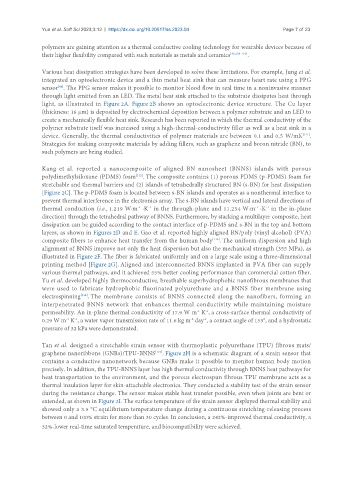
               Various heat dissipation strategies have been developed to solve these limitations. For example, Jung et al.
               integrated an optoelectronic device and a thin metal heat sink that can measure heart rate using a PPG
               sensor . The PPG sensor makes it possible to monitor blood flow in real time in a noninvasive manner
                     [46]
               through light emitted from an LED. The metal heat sink attached to the substrate dissipates heat through
               light, as illustrated in Figure 2A. Figure 2B shows an optoelectronic device structure. The Cu layer
               (thickness: 16 µm) is deposited by electrochemical deposition between a polymer substrate and an LED to
               create a mechanically flexible heat sink. Research has been reported in which the thermal conductivity of the
               polymer substrate itself was increased using a high-thermal-conductivity filler as well as a heat sink in a
                                                                                                       [111]
               device. Generally, the thermal conductivities of polymer materials are between 0.1 and 0.5 W/mK .
               Strategies for making composite materials by adding fillers, such as graphene and boron nitride (BN), to
               such polymers are being studied.


               Kang  et  al.  reported  a  nanocomposite  of  aligned  BN  nanosheet  (BNNS)  islands  with  porous
                                               [112]
               polydimethylsiloxane (PDMS) foam . The composite contains (1) porous PDMS (p-PDMS) foam for
               stretchable and thermal barriers and (2) islands of tetrahedrally structured BN (s-BN) for heat dissipation
               [Figure 2C]. The p-PDMS foam is located between s-BN islands and operates as a nonthermal interface to
               prevent thermal interference in the electronics array. The s-BN islands have vertical and lateral directions of
                                                                                           -1
               thermal conduction (i.e., 1.219 W·m  ·K  in the through-plane and 11.234 W·m  ·K  in the in-plane
                                               -1
                                                   -1
                                                                                       -1
               direction) through the tetrahedral pathway of BNNS. Furthermore, by stacking a multilayer composite, heat
               dissipation can be guided according to the contact interface of p-PDMS and s-BN in the top and bottom
               layers, as shown in Figures 2D and E. Gao et al. reported highly aligned BN/poly (vinyl alcohol) (PVA)
               composite fibers to enhance heat transfer from the human body . The uniform dispersion and high
                                                                         [113]
               alignment of BNNS improve not only the heat dispersion but also the mechanical strength (355 MPa), as
               illustrated in Figure 2F. The fiber is fabricated uniformly and on a large scale using a three-dimensional
               printing method [Figure 2G]. Aligned and interconnected BNNS implanted in PVA fiber can supply
               various thermal pathways, and it achieved 55% better cooling performance than commercial cotton fiber.
               Yu et al. developed highly thermoconductive, breathable superhydrophobic nanofibrous membranes that
               were used to fabricate hydrophobic fluorinated polyurethane and a BNNS fiber membrane using
               electrospinning . The membrane consists of BNNS connected along the nanofibers, forming an
                            [114]
               interpenetrated BNNS network that enhances thermal conductivity while maintaining moisture
               permeability. An in-plane thermal conductivity of 17.9 W m  K , a cross-surface thermal conductivity of
                                                                   -1
                                                                      -1
                       -1
                          -1
                                                                 -2
                                                                      -1
               0.29 W m  K , a water vapor transmission rate of 11.6 kg m  day , a contact angle of 153°, and a hydrostatic
               pressure of 32 kPa were demonstrated.
               Tan et al. designed a stretchable strain sensor with thermoplastic polyurethane (TPU) fibrous mats/
                                                     [115]
               graphene nanoribbons (GNRs)/TPU-BNNS . Figure 2H is a schematic diagram of a strain sensor that
               contains a conductive nanonetwork because GNRs make it possible to monitor human body motion
               precisely. In addition, the TPU-BNNS layer has high thermal conductivity through BNNS heat pathways for
               heat transportation to the environment, and the porous electrospun fibrous TPU membrane acts as a
               thermal insulation layer for skin-attachable electronics. They conducted a stability test of the strain sensor
               during the resistance change. The sensor makes stable heat transfer possible, even when joints are bent or
               extended, as shown in Figure 2I. The surface temperature of the strain sensor displayed thermal stability and
               showed only a 3.5 °C equilibrium temperature change during a continuous stretching-releasing process
               between 0 and 100% strain for more than 30 cycles. In conclusion, a 242%-improved thermal conductivity, a
               32%-lower real-time saturated temperature, and biocompatibility were achieved.

