


Page 34 - Read Online
P. 34
Yun et al. Soft Sci 2023;3:12  https://dx.doi.org/10.20517/ss.2023.04            Page 5 of 23


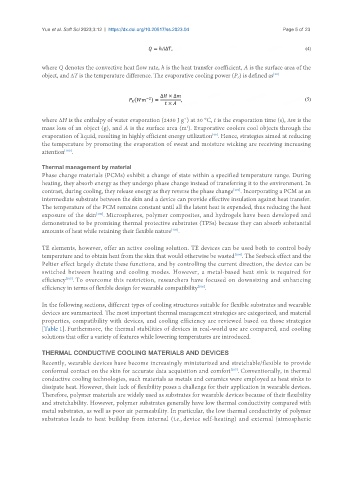
               where Q denotes the convective heat flow rate, h is the heat transfer coefficient, A is the surface area of the
               object, and ΔT is the temperature difference. The evaporative cooling power (P ) is defined as [98]
                                                                                 E


                                                               -1
               where ΔH is the enthalpy of water evaporation (2430 J g ) at 30 °C, t is the evaporation time (s), Δm is the
                                                                2
               mass loss of an object (g), and A is the surface area (m ). Evaporative coolers cool objects through the
               evaporation of liquid, resulting in highly efficient energy utilization . Hence, strategies aimed at reducing
                                                                         [99]
               the temperature by promoting the evaporation of sweat and moisture wicking are receiving increasing
               attention .
                       [100]

               Thermal management by material
               Phase change materials (PCMs) exhibit a change of state within a specified temperature range. During
               heating, they absorb energy as they undergo phase change instead of transferring it to the environment. In
               contrast, during cooling, they release energy as they reverse the phase change . Incorporating a PCM as an
                                                                                [101]
               intermediate substrate between the skin and a device can provide effective insulation against heat transfer.
               The temperature of the PCM remains constant until all the latent heat is expended, thus reducing the heat
               exposure of the skin . Microspheres, polymer composites, and hydrogels have been developed and
                                 [102]
               demonstrated to be promising thermal protective substrates (TPSs) because they can absorb substantial
               amounts of heat while retaining their flexible nature .
                                                           [103]
               TE elements, however, offer an active cooling solution. TE devices can be used both to control body
               temperature and to obtain heat from the skin that would otherwise be wasted . The Seebeck effect and the
                                                                                [104]
               Peltier effect largely dictate these functions, and by controlling the current direction, the device can be
               switched between heating and cooling modes. However, a metal-based heat sink is required for
                       [105]
               efficiency . To overcome this restriction, researchers have focused on downsizing and enhancing
               efficiency in terms of flexible design for wearable compatibility .
                                                                    [106]
               In the following sections, different types of cooling structures suitable for flexible substrates and wearable
               devices are summarized. The most important thermal management strategies are categorized, and material
               properties, compatibility with devices, and cooling efficiency are reviewed based on those strategies
               [Table 1]. Furthermore, the thermal stabilities of devices in real-world use are compared, and cooling
               solutions that offer a variety of features while lowering temperatures are introduced.


               THERMAL CONDUCTIVE COOLING MATERIALS AND DEVICES
               Recently, wearable devices have become increasingly miniaturized and stretchable/flexible to provide
                                                                               [107]
               conformal contact on the skin for accurate data acquisition and comfort . Conventionally, in thermal
               conductive cooling technologies, such materials as metals and ceramics were employed as heat sinks to
               dissipate heat. However, their lack of flexibility poses a challenge for their application in wearable devices.
               Therefore, polymer materials are widely used as substrates for wearable devices because of their flexibility
               and stretchability. However, polymer substrates generally have low thermal conductivity compared with
               metal substrates, as well as poor air permeability. In particular, the low thermal conductivity of polymer
               substrates leads to heat buildup from internal (i.e., device self-heating) and external (atmospheric

