


Page 33 - Read Online
P. 33
Page 4 of 23                             Yun et al. Soft Sci 2023;3:12  https://dx.doi.org/10.20517/ss.2023.04


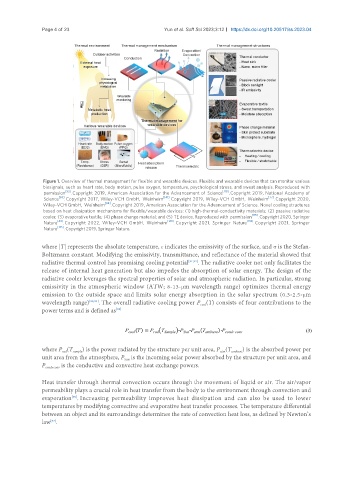
                Figure 1. Overview of thermal management for flexible and wearable devices. Flexible and wearable devices that can monitor various
                biosignals, such as heart rate, body motion, pulse oxygen, temperature, psychological stress, and sweat analysis. Reproduced with
                       [53]                                                 [118]
                permission  . Copyright 2019, American Association for the Advancement of  Science  . Copyright 2019, National Academy of
                Science [63] . Copyright 2017, Wiley-VCH GmbH,  Weinheim [141] . Copyright 2019, Wiley-VCH GmbH,  Weinheim [77] . Copyright 2020,
                Wiley-VCH GmbH,  Weinheim [84] . Copyright 2019, American Association for the Advancement of Science. Novel cooling structures
                based on heat dissipation mechanisms for flexible/wearable devices: (1) high-thermal-conductivity materials; (2) passive radiative
                cooler; (3) evaporative textile; (4) phase change material; and (5) TE device. Reproduced with permission [115] . Copyright 2020, Springer
                Nature [43] . Copyright  2022,  Wiley-VCH  GmbH,  Weinheim [120] . Copyright  2021,  Springer  Nature [132] . Copyright  2021,  Springer
                Nature [135] . Copyright 2019, Springer Nature.

               where |T| represents the absolute temperature, ε indicates the emissivity of the surface, and σ is the Stefan-
               Boltzmann constant. Modifying the emissivity, transmittance, and reflectance of the material showed that
               radiative thermal control has promising cooling potential [91,92] . The radiative cooler not only facilitates the
               release of internal heat generation but also impedes the absorption of solar energy. The design of the
               radiative cooler leverages the spectral properties of solar and atmospheric radiation. In particular, strong
               emissivity in the atmospheric window (ATW; 8-13-μm wavelength range) optimizes thermal energy
               emission to the outside space and limits solar energy absorption in the solar spectrum (0.3-2.5-μm
               wavelength range) [93,94] . The overall radiative cooling power P (T) consists of four contributions to the
                                                                     cool
               power terms and is defined as [95]


               where P (T sample ) is the power radiated by the structure per unit area, P (T ambient ) is the absorbed power per
                      rad
                                                                           atm
               unit area from the atmosphere, P  is the incoming solar power absorbed by the structure per unit area, and
                                           Sun
               P cond+conv  is the conductive and convective heat exchange powers.
               Heat transfer through thermal convection occurs through the movement of liquid or air. The air/vapor
               permeability plays a crucial role in heat transfer from the body to the environment through convection and
                         [96]
               evaporation . Increasing  permeability  improves  heat  dissipation  and  can  also  be  used  to  lower
               temperatures by modifying convective and evaporative heat transfer processes. The temperature differential
               between an object and its surroundings determines the rate of convection heat loss, as defined by Newton’s
               law .
                  [97]

