


Page 35 - Read Online
P. 35
Page 6 of 23                             Yun et al. Soft Sci 2023;3:12  https://dx.doi.org/10.20517/ss.2023.04

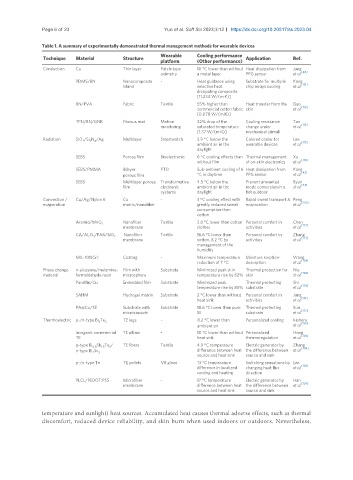
               Table 1. A summary of experimentally demonstrated thermal management methods for wearable devices
                                                       Wearable    Cooling performance
                Technique  Material        Structure                                Application     Ref.
                                                       platform    (Other performance)
                Conduction  Cu             Thin layer  Patch-type   10 °C lower than without  Heat dissipation from   Jung
                                                       oximetry    a metal layer    PPG sensor      et al. [46]
                           PDMS/BN         Nanocomposite   -       Heat guidance using   Substrate for multiple   Kang
                                           island                  selective heat   chip arrays cooling  et al. [131]
                                                                   dissipating composite
                                                                   [11.234 W/(m·K)]
                           BN/PVA          Fabric      Textile     55% higher than   Heat transfer from the   Gao
                                                                   commercial cotton fabric  skin   et al. [113]
                                                                   [0.078 W/(m·K)]
                           TPU/BN/GNR      Fibrous mat  Motion     32% drop of the   Cooling resistance   Tan
                                                       monitoring  saturated temperature   change under   et al. [115]
                                                                   [1.37 W/(m·K)]   mechanical stimuli
                Radiation  SiO /Si N /Ag   Multilayer  Smartwatch  3.9 °C below the   Colored cooler for   Lee
                                 4
                             2
                               3
                                                                   ambient air in the   wearable devices  et al. [117]
                                                                   daylight
                           SEBS            Porous film  Bioelectronic  6 °C cooling effects than  Thermal management   Xu
                                                                                                       [118]
                                                                   without film     of on-skin electronics  et al.
                           SEBS/PMMA       Bilayer     PTO         Sub-ambient cooling of 6 Heat dissipation from   Kang
                                                                                                       [42]
                                           porous film             °C in daytime    PPG sensor      et al.
                           SEBS            Multilayer porous  Transformative   4.5 °C below the   Prevent unwanted   Byun
                                           film        electronic   ambient air in the   mode conversion in a   et al. [43]
                                                       systems     daylight         hot outdoor
                Convection /   Cu/Ag/Nylon 6  Cu       -           3 °C cooling effect with   Rapid sweat transport &  Peng
                evaporation                matrix/nanofiber        greatly reduced sweat   evaporation  et al. [120]
                                                                   consumption than
                                                                   cotton
                           Aramid/MnO      Nanofiber   Textile     3.8 °C lower than cotton  Personal comfort in   Chen
                                   2                                                                   [122]
                                           membrane                clothes          activities      et al.
                           CA/Al O /PA6/SiO  Nanofiber  Textile    16.6 °C lower than   Personal comfort in   Zhang
                               2  3    2                                                               [123]
                                           membrane                cotton, 8.2 °C by   activities   et al.
                                                                   management of the
                                                                   humidity
                           MIL-101(Cr)     Coating     -           Maximum temperature  Moisture sorption-  Wang
                                                                                                       [124]
                                                                   reduction of 7 °C  desorption    et al.
                Phase change   n-eicosane/melamine-  Film with   Substrate  Minimized peak skin   Thermal protection for   Nie
                                                                                                       [129]
                material   formaldehyde resin  microsphere         temperature rise by 82% skin     et al.
                           Paraffin/Cu     Embedded film  Substrate  Minimized peak   Thermal protecting   Shi
                                                                                                       [130]
                                                                   temperature rise by 85% substrate  et al.
                           SAHM            Hydrogel matrix  Substrate  2 °C lower than without  Personal comfort in   Jung
                                                                                                       [131]
                                                                   heat sink        activities      et al.
                           PA@Cu/SE        Substrate with   Substrate  18.6 °C lower than pure  Thermal protecting   Sun
                                                                                                       [132]
                                           microcapsule            SE               substrate       et al.
                Thermoelectric  p-/n-type Bi Te 3  TE legs  -       8.2 °C lower than  Personalized cooling  Kishore
                                  2
                                                                    ambient air                     et al. [135]
                           Inorganic commercial   TE pillars  -    10 °C lower than without  Personalized   Hong
                           TE                                      heat sink        thermoregulation  et al. [136]
                           p-type Bi Sb Te /  TE fibers  Textile   4.9 °C temperature   Electric generator by   Zhang
                                0.5  1.5  3                                                            [104]
                           n-type Bi Se 3                          difference between heat  the difference between  et al.
                                2
                                                                   source and heat sink  source and sink
                           p-/n-type Te    TE pellets  VR glove     13 °C temperature  Switching sensations by  Lee
                                                                                                       [138]
                                                                   difference in localized  changing heat flux   et al.
                                                                   cooling and heating  direction
                           PLCL/PEDOT:PSS  Microfiber  -           17 °C temperature   Electric generator by   Han
                                                                                                       [139]
                                           membrane                difference between heat  the difference between  et al.
                                                                   source and heat sink  source and sink
               temperature and sunlight) heat sources. Accumulated heat causes thermal adverse effects, such as thermal
               discomfort, reduced device reliability, and skin burn when used indoors or outdoors. Nevertheless,

