


Page 41 - Read Online
P. 41
Page 12 of 23                            Yun et al. Soft Sci 2023;3:12  https://dx.doi.org/10.20517/ss.2023.04


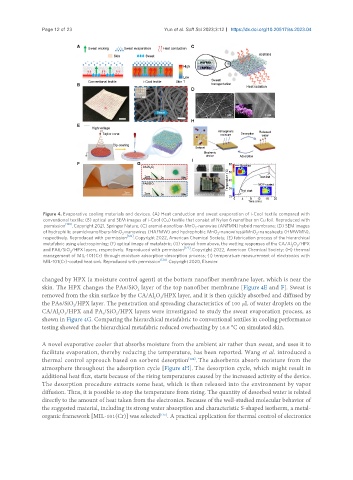
                Figure 4. Evaporative cooling materials and devices. (A) Heat conduction and sweat evaporation of i-Cool textile compared with
                conventional textile; (B) optical and SEM images of i-Cool (Cu) textile that consist of Nylon 6 nanofiber on Cu foil. Reproduced with
                permission [120] . Copyright 2021, Springer Nature; (C) aramid-nanofiber-MnO -nanowire (ANFMN) hybrid membrane; (D) SEM images
                                                                   2
                of hydrophilic aramid-nanofibers-MnO -nanowires (HAFMW) and hydrophobic MnO -nanowires@MnO -nanosheets (HMWMN),
                                                                          2
                                                                                       2
                                          2
                respectively. Reproduced with permission [122] . Copyright 2022, American Chemical Society; (E) fabrication process of the hierarchical
                metafabric using electrospinning; (F) optical image of metafabric; (G) viewed from above, the wetting responses of the CA/Al O /HPX
                                                                                                   2
                                                                                                     3
                and PA6/SiO /HPX layers, respectively. Reproduced with  permission [123] . Copyright 2022, American Chemical Society; (H) thermal
                         2
                management of MIL-101(Cr) through moisture adsorption-desorption process; (I) temperature measurement of electronics with
                MIL-101(Cr)-coated heat sink. Reproduced with permission [124] . Copyright 2020, Elsevier.
               changed by HPX (a moisture control agent) at the bottom nanofiber membrane layer, which is near the
               skin. The HPX changes the PA6/SiO  layer of the top nanofiber membrane [Figure 4E and F]. Sweat is
                                               2
               removed from the skin surface by the CA/Al O /HPX layer, and it is then quickly absorbed and diffused by
                                                     2
                                                       3
               the PA6/SiO /HPX layer. The penetration and spreading characteristics of 100 μL of water droplets on the
                          2
               CA/Al O /HPX and PA /SiO /HPX layers were investigated to study the sweat evaporation process, as
                                        2
                                    6
                       3
                     2
               shown in Figure 4G. Comparing the hierarchical metafabric to conventional textiles in cooling performance
               testing showed that the hierarchical metafabric reduced overheating by 16.6 °C on simulated skin.
               A novel evaporative cooler that absorbs moisture from the ambient air rather than sweat, and uses it to
               facilitate evaporation, thereby reducing the temperature, has been reported. Wang et al. introduced a
                                                                 [124]
               thermal control approach based on sorbent desorption . The adsorbents absorb moisture from the
               atmosphere throughout the adsorption cycle [Figure 4H]. The desorption cycle, which might result in
               additional heat flux, starts because of the rising temperatures caused by the increased activity of the device.
               The desorption procedure extracts some heat, which is then released into the environment by vapor
               diffusion. Thus, it is possible to stop the temperature from rising. The quantity of desorbed water is related
               directly to the amount of heat taken from the electronics. Because of the well-studied molecular behavior of
               the suggested material, including its strong water absorption and characteristic S-shaped isotherm, a metal-
               organic framework [MIL-101(Cr)] was selected . A practical application for thermal control of electronics
                                                       [125]

