


Page 45 - Read Online
P. 45
Page 16 of 23                            Yun et al. Soft Sci 2023;3:12  https://dx.doi.org/10.20517/ss.2023.04


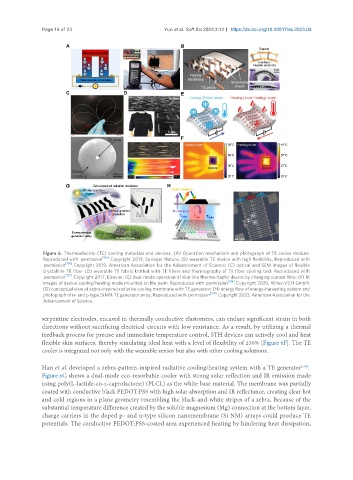
                Figure 6. Thermoelectric (TE) cooling materials and devices. (A) Operation mechanism and photograph of TE cooler module.
                Reproduced with  permission [135] . Copyright 2019, Springer Nature; (B) wearable TE device with high flexibility. Reproduced with
                permission [136] . Copyright 2019, American Association for the Advancement of Science; (C) optical and SEM images of flexible
                crystalline TE fiber (D) wearable TE fabric knitted with TE fibers and thermography of TE fiber cooling test. Reproduced with
                permission [137] . Copyright 2017, Elsevier; (E) dual-mode operation of skin-like thermo-haptic device by changing current flow; (F) IR
                images of device cooling/heating mode mounted on the palm. Reproduced with  permission [138] . Copyright 2020, Wiley-VCH GmbH;
                (G) conceptual view of zebra-inspired radiative cooling membrane with TE generator; (H) energy flow of energy-harvesting system and
                photograph of n- and p-type Si NM TE generator array. Reproduced with permission [139] . Copyright 2023, American Association for the
                Advancement of Science.

               serpentine electrodes, encased in thermally conductive elastomers, can endure significant strain in both
               directions without sacrificing electrical circuits with low resistance. As a result, by utilizing a thermal
               feedback process for precise and immediate temperature control, STH devices can actively cool and heat
               flexible skin surfaces, thereby simulating ideal heat with a level of flexibility of 230% [Figure 6F]. The TE
               cooler is integrated not only with the wearable sensor but also with other cooling solutions.

               Han et al. developed a zebra-pattern-inspired radiative cooling/heating system with a TE generator .
                                                                                                      [139]
               Figure 6G shows a dual-mode eco-resorbable cooler with strong solar reflection and IR emission made
               using poly(L-lactide-co-ε-caprolactone) (PLCL) as the white base material. The membrane was partially
               coated with conductive black PEDOT:PSS with high solar absorption and IR reflectance, creating clear hot
               and cold regions in a plane geometry resembling the black-and-white stripes of a zebra. Because of the
               substantial temperature difference created by the soluble magnesium (Mg) connection at the bottom layer,
               charge carriers in the doped p- and n-type silicon nanomembrane (Si NM) arrays could produce TE
               potentials. The conductive PEDOT:PSS-coated area experienced heating by hindering heat dissipation,

