


Page 43 - Read Online
P. 43
Page 14 of 23                            Yun et al. Soft Sci 2023;3:12  https://dx.doi.org/10.20517/ss.2023.04


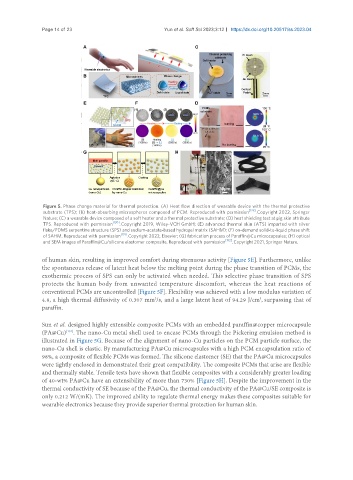
                Figure 5. Phase change material for thermal protection. (A) Heat flow direction of wearable device with the thermal protective
                substrate (TPS); (B) heat-absorbing microspheres composed of PCM. Reproduced with  permission [129] . Copyright 2022, Springer
                Nature; (C) a wearable device composed of a soft heater and a thermal protective substrate; (D) heat shielding test at pig skin attribute
                TPS. Reproduced with  permission [130] . Copyright 2019, Wiley-VCH GmbH; (E) advanced thermal skin (ATS) imparted with silver
                flake/PDMS serpentine structure (SPS) and sodium-acetate-based hydrogel matrix (SAHM); (F) on-demand solid-to-liquid phase shift
                of SAHM. Reproduced with permission [131] . Copyright 2022, Elsevier; (G) fabrication process of Paraffin@Cu microcapsules; (H) optical
                and SEM images of Paraffin@Cu/silicone elastomer composite. Reproduced with permission [132] . Copyright 2021, Springer Nature.


               of human skin, resulting in improved comfort during strenuous activity [Figure 5E]. Furthermore, unlike
               the spontaneous release of latent heat below the melting point during the phase transition of PCMs, the
               exothermic process of SPS can only be activated when needed. This selective phase transition of SPS
               protects the human body from unwanted temperature discomfort, whereas the heat reactions of
               conventional PCMs are uncontrolled [Figure 5F]. Flexibility was achieved with a low modulus variation of
                                                     2
                                                                                         3
               4.8, a high thermal diffusivity of 0.307 mm /s, and a large latent heat of 94.29 J/cm , surpassing that of
               paraffin.

               Sun et al. designed highly extensible composite PCMs with an embedded paraffin@copper microcapsule
               (PA@Cu) . The nano-Cu metal shell used to encase PCMs through the Pickering emulsion method is
                       [132]
               illustrated in Figure 5G. Because of the alignment of nano-Cu particles on the PCM particle surface, the
               nano-Cu shell is elastic. By manufacturing PA@Cu microcapsules with a high PCM encapsulation ratio of
               98%, a composite of flexible PCMs was formed. The silicone elastomer (SE) that the PA@Cu microcapsules
               were tightly enclosed in demonstrated their great compatibility. The composite PCMs that arise are flexible
               and thermally stable. Tensile tests have shown that flexible composites with a considerably greater loading
               of 40-wt% PA@Cu have an extensibility of more than 730% [Figure 5H]. Despite the improvement in the
               thermal conductivity of SE because of the PA@Cu, the thermal conductivity of the PA@Cu/SE composite is
               only 0.212 W/(mK). The improved ability to regulate thermal energy makes these composites suitable for
               wearable electronics because they provide superior thermal protection for human skin.

