


Page 203 - Read Online
P. 203
Nam et al. Soft Sci 2023;3:28  https://dx.doi.org/10.20517/ss.2023.19           Page 27 of 35


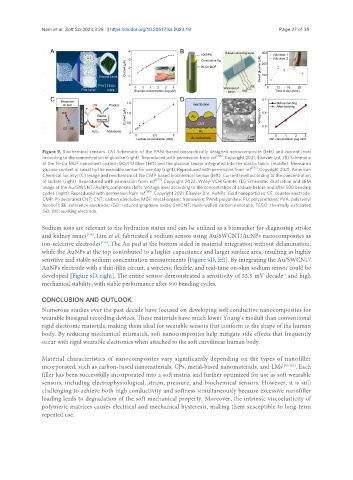
               Figure 9. Biochemical sensors. (A) Schematic of the PANI-based hierarchically designed nanocomposite (left) and current level
               according to the concentration of glucose (right). Reproduced with permission from ref [196] . Copyright 2021, Elsevier Ltd; (B) Schematic
               of the Ni-Co MOF nanosheet coated rGO/PU fiber (left) and the glucose sensor integrated into the elastic fabric (middle). Measured
               glucose content in sweat by the wearable sensor for one day (right). Reproduced with permission from ref [197] . Copyright 2021, American
               Chemical Society; (C) Image and mechanism of the CMP-based biochemical sensor (left). Current level according to the concentration
               of lactate (right). Reproduced with permission from  ref [154] . Copyright 2022, Wiley-VCH GmbH; (D) Schematic illustration and SEM
               image of the Au/SWCNT/AuNPs composite (left). Voltage level according to the concentration of sodium before and after 500 bending
               cycles (right). Reproduced with permission from ref [199] . Copyright 2021, Elsevier B.V. AuNPs: Gold nanoparticles; CE: counter electrode;
               CMP: Pt-decorated CNT; CNT: carbon nanotube; MOF: metal-organic framework; PANI: polyaniline; PU: polyurethane; PVA: poly(vinyl
               alcohol); RE: reference electrode; rGO: reduced graphene oxide; SWCNT: multi-walled carbon nanotube; TEGO: thermally-exfoliated
               GO; WE: working electrode.

               Sodium ions are relevant to the hydration status and can be utilized as a biomarker for diagnosing stroke
               and kidney issues . Lim et al. fabricated a sodium sensor using Au/SWCNT/AuNPs nanocomposites as
                              [198]
               ion-selective electrodes . The Au pad at the bottom aided in material integration without delamination,
                                   [199]
               while the AuNPs at the top contributed to a higher capacitance and larger surface area, resulting in highly
               sensitive and stable sodium concentration measurements [Figure 9D, left]. By integrating the Au/SWCNT/
               AuNPs electrode with a thin-film circuit, a wireless, flexible, and real-time on-skin sodium sensor could be
               developed [Figure 9D, right]. The entire sensor demonstrated a sensitivity of 55.5 mV decade  and high
                                                                                                -1
               mechanical stability, with stable performance after 500 bending cycles.


               CONCLUSION AND OUTLOOK
               Numerous studies over the past decade have focused on developing soft conductive nanocomposites for
               wearable biosignal recording devices. These materials have much lower Young’s moduli than conventional
               rigid electronic materials, making them ideal for wearable sensors that conform to the shape of the human
               body. By reducing mechanical mismatch, soft nanocomposites help mitigate side effects that frequently
               occur with rigid wearable electronics when attached to the soft curvilinear human body.


               Material characteristics of nanocomposites vary significantly depending on the types of nanofiller
               incorporated, such as carbon-based nanomaterials, CPs, metal-based nanomaterials, and LMs [200-202] . Each
               filler has been successfully incorporated into a soft matrix and further optimized for use as soft wearable
               sensors, including electrophysiological, strain, pressure, and biochemical sensors. However, it is still
               challenging to achieve both high conductivity and softness simultaneously because excessive nanofiller
               loading leads to degradation of the soft mechanical property. Moreover, the intrinsic viscoelasticity of
               polymeric matrices causes electrical and mechanical hysteresis, making them susceptible to long-term
               repeated use.

