


Page 201 - Read Online
P. 201
Nam et al. Soft Sci 2023;3:28  https://dx.doi.org/10.20517/ss.2023.19           Page 25 of 35


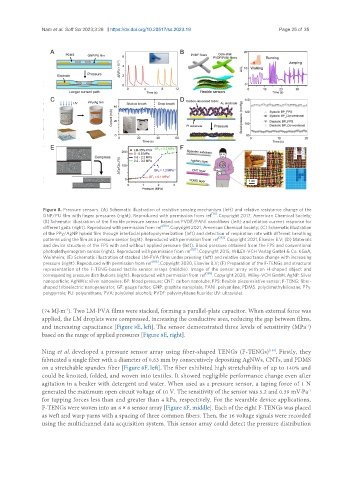
                Figure 8. Pressure sensors. (A) Schematic illustration of resistive sensing mechanism (left) and relative resistance change of the
                GNP/PU film with finger pressures (right). Reproduced with permission from  ref [70] . Copyright 2017, American Chemical Society;
                (B) Schematic illustration of the flexible pressure sensor based on PVDF/PANI nanofibers (left) and relative current response for
                different gaits (right). Reproduced with permission from ref [180] . Copyright 2021, American Chemical Society; (C) Schematic illustration
                of the PPy/AgNP hybrid film through interfacial photopolymerization (left) and detection of respiration rate with different breathing
                patterns using the film as a pressure sensor (right). Reproduced with permission from ref [183] . Copyright 2021, Elsevier B.V; (D) Materials
                and device structure of the FPS with and without applied pressure (left). Blood pressure obtained from the FPS and conventional
                photoplethysmogram sensor (right). Reproduced with permission from ref [187] . Copyright 2015, WILEY-VCH Verlag GmbH & Co. KGaA,
                Weinheim; (E) Schematic illustration of stacked LM-PVA films under pressing (left) and relative capacitance change with increasing
                pressure (right). Reproduced with permission from ref [188] . Copyright 2020, Elsevier B.V; (F) Preparation of the F-TENGs and structural
                representation of the F-TENG-based tactile sensor arrays (middle). Image of the sensor array with an H-shaped object and
                corresponding pressure distributions (right). Reproduced with permission from ref [189] . Copyright 2020, Wiley-VCH GmbH. AgNP: Silver
                nanoparticle; AgNWs: silver nanowires; BP: blood pressure; CNT: carbon nanotube; FPS: flexible piezoresistive sensor; F-TENG: fiber-
                shaped triboelectric nanogenerator; GF: gauge factor; GNP: graphite nanoplate; PANI: polyaniline; PDMS: polydimethylsiloxane; PPy:
                polypyrrole; PU: polyurethane; PVA: poly(vinyl alcohol); PVDF: polyvinylidene fluoride; UV: ultraviolet.


                       -3
               (74 MJ·m ). Two LM-PVA films were stacked, forming a parallel-plate capacitor. When external force was
               applied, the LM droplets were compressed, increasing the conductive area, reducing the gap between films,
                                                                                                        -1
               and increasing capacitance [Figure 8E, left]. The sensor demonstrated three levels of sensitivity (MPa )
               based on the range of applied pressures [Figure 8E, right].

               Ning et al. developed a pressure sensor array using fiber-shaped TENGs (F-TENGs) . Firstly, they
                                                                                            [189]
               fabricated a single fiber with a diameter of 0.63 mm by consecutively depositing AgNWs, CNTs, and PDMS
               on a stretchable spandex fiber [Figure 8F, left]. The fiber exhibited high stretchability of up to 140% and
               could be knotted, folded, and woven into textiles. It showed negligible performance change even after
               agitation in a beaker with detergent and water. When used as a pressure sensor, a taping force of 1 N
                                                                                                         -1
               generated the maximum open circuit voltage of 10 V. The sensitivity of the sensor was 5.2 and 0.39 mV·Pa
               for tapping forces less than and greater than 4 kPa, respectively. For the wearable device applications,
               F-TENGs were woven into an 8 × 8 sensor array [Figure 8F, middle]. Each of the eight F-TENGs was placed
               as weft and warp yarns with a spacing of three common fibers. Then, the 16 voltage signals were recorded
               using the multichannel data acquisition system. This sensor array could detect the pressure distribution

