


Page 196 - Read Online
P. 196
Page 20 of 35                           Nam et al. Soft Sci 2023;3:28  https://dx.doi.org/10.20517/ss.2023.19


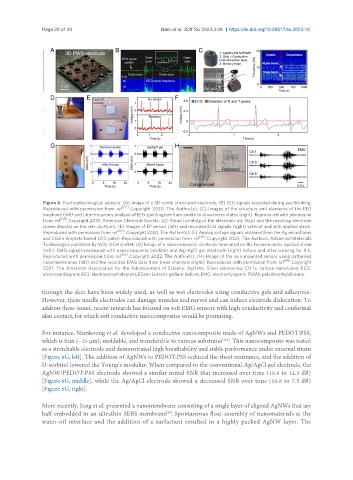
                Figure 6. Electrophysiological sensors. (A) Image of a 3D-comb structured electrode; (B) EEG signals recorded during eye-blinking.
                Reproduced with permission from  ref [152] . Copyright 2020, The Author(s); (C) Images of the structure and elements of the EEG
                earphone (left) and time-frequency analysis of EEG spectrogram from awake to drowsiness states (right). Reproduced with permission
                from  ref [158] . Copyright 2018, American Chemical Society; (D) Stencil printing of the electronic ink (top) and the resulting electrode
                drawn directly on the skin (bottom); (E) Images of EP sensor (left) and recorded ECG signals (right) without and with applied strain.
                Reproduced with permission from ref [160] . Copyright 2020, The Author(s); (F) Analog voltage signals obtained from the Ag microflakes
                and EGaIn droplets-based ECG patch. Reproduced with permission from  ref [161] . Copyright 2022, The Authors. Advanced Materials
                Technologies published by Wile-VCH GmbH; (G) Image of a nanocomposite electrode laminated on the forearm under applied strain
                (left). EMG signals measured with nanocomposite (middle) and Ag/AgCl gel electrode (right) before and after wearing for 8 h.
                Reproduced with permission from  ref [162] . Copyright 2022, The Author(s); (H) Image of the skin-mounted sensor using patterned
                nanomembranes (left) and the recorded EMG data from three channels (right). Reproduced with permission from  ref [44] . Copyright
                2021, The American Association for the Advancement of Science. AgNWs: Silver nanowires; CNTs: carbon nanotubes; ECG:
                electrocardiogram; EEG: electroencephalogram; EGaIn: Eutectic gallium-indium; EMG: electromyogram; PDMS: polydimethylsiloxane.


               through the skin have been widely used, as well as wet electrodes using conductive gels and adhesives.
               However, these needle electrodes can damage muscles and nerves and can induce electrode dislocation. To
               address these issues, recent research has focused on soft EMG sensors with high conductivity and conformal
               skin contact, for which soft conductive nanocomposites would be promising.

               For instance, Namkoong et al. developed a conductive nanocomposite made of AgNWs and PEDOT:PSS,
               which is thin (~25 µm), moldable, and transferable to various substrates . This nanocomposite was tested
                                                                            [162]
               as a stretchable electrode and demonstrated high breathability and stable performance under external strain
               [Figure 6G, left]. The addition of AgNWs to PEDOT:PSS reduced the sheet resistance, and the addition of
               D-sorbitol lowered the Young’s modulus. When compared to the conventional Ag/AgCl gel electrode, the
               AgNW/PEDOT:PSS electrode showed a similar initial SNR that increased over time (10.9 to 12.3 dB)
               [Figure 6G, middle], while the Ag/AgCl electrode showed a decreased SNR over time (10.6 to 7.5 dB)
               [Figure 6G, right].

               More recently, Jung et al. presented a nanomembrane consisting of a single layer of aligned AgNWs that are
                                                         [44]
               half-embedded in an ultrathin SEBS membrane . Spontaneous float-assembly of nanomaterials at the
               water-oil interface and the addition of a surfactant resulted in a highly packed AgNW layer. The

