


Page 198 - Read Online
P. 198
Page 22 of 35                           Nam et al. Soft Sci 2023;3:28  https://dx.doi.org/10.20517/ss.2023.19


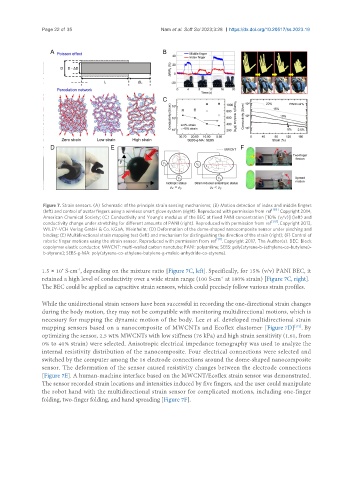
                Figure 7. Strain sensors. (A) Schematic of the principle strain sensing mechanisms; (B) Motion detection of index and middle fingers
                                                                                             [169]
                (left) and control of avatar fingers using a wireless smart glove system (right). Reproduced with permission from ref  . Copyright 2014,
                American Chemical Society; (C) Conductivity and Young’s modulus of the BEC at fixed PANI concentration [10% (v/v)] (left) and
                                                                                            [170]
                conductivity change under stretching for different amounts of PANI (right). Reproduced with permission from ref  . Copyright 2013,
                WILEY-VCH Verlag GmbH & Co. KGaA, Weinheim; (D) Deformation of the dome-shaped nanocomposite sensor under pinching and
                binding; (E) Multidirectional strain mapping test (left) and mechanism for distinguishing the direction of the strain (right); (F) Control of
                                                                          [171]
                robotic finger motions using the strain sensor. Reproduced with permission from  ref  . Copyright 2017, The Author(s). BEC: Block
                copolymer elastic conductor; MWCNT: multi-walled carbon nanotube; PANI: polyaniline; SEBS: poly[styrene-b-(ethylene-co-butylene)-
                b-styrene]; SEBS-g-MA: poly(styrene-co-ethylene-butylene-g-maleic-anhydride-co-styrene).
               1.5 × 10  S·cm , depending on the mixture ratio [Figure 7C, left]. Specifically, for 15% (v/v) PANI BEC, it
                      4
                           -1
               retained a high level of conductivity over a wide strain range (100 S·cm  at 180% strain) [Figure 7C, right].
                                                                           -1
               The BEC could be applied as capacitive strain sensors, which could precisely follow various strain profiles.
               While the unidirectional strain sensors have been successful in recording the one-directional strain changes
               during the body motion, they may not be compatible with monitoring multidirectional motions, which is
               necessary for mapping the dynamic motion of the body. Lee et al. developed multidirectional strain
               mapping sensors based on a nanocomposite of MWCNTs and Ecoflex elastomer [Figure 7D] . By
                                                                                                    [171]
               optimizing the sensor, 2.5 wt% MWCNTs with low stiffness (76 kPa) and high strain sensitivity (1.61, from
               0% to 40% strain) were selected. Anisotropic electrical impedance tomography was used to analyze the
               internal resistivity distribution of the nanocomposite. Four electrical connections were selected and
               switched by the computer among the 16 electrode connections around the dome-shaped nanocomposite
               sensor. The deformation of the sensor caused resistivity changes between the electrode connections
               [Figure 7E]. A human-machine interface based on the MWCNT/Ecoflex strain sensor was demonstrated.
               The sensor recorded strain locations and intensities induced by five fingers, and the user could manipulate
               the robot hand with the multidirectional strain sensor for complicated motions, including one-finger
               folding, two-finger folding, and hand spreading [Figure 7F].

