


Page 148 - Read Online
P. 148
Li et al. Soft Sci 2023;3:22  https://dx.doi.org/10.20517/ss.2023.11            Page 11 of 15


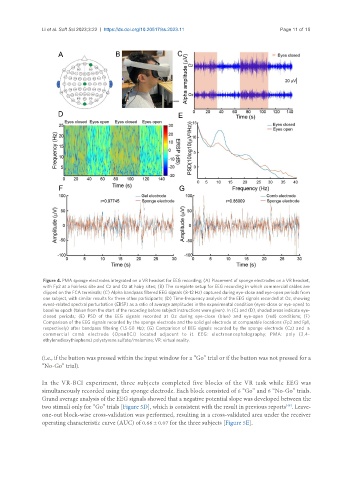
                Figure 4. PMA sponge electrodes integrated on a VR headset for EEG recording; (A) Placement of sponge electrodes on a VR headset,
                with Fp2 at a hairless site and Cz and Oz at hairy sites; (B) The complete setup for EEG recording in which commercial cables are
                clipped on the FCA terminals; (C) Alpha bandpass filtered EEG signals (8-12 Hz) captured during eye-close and eye-open periods from
                one subject, with similar results for three other participants; (D) Time-frequency analysis of the EEG signals recorded at Oz, showing
                event-related spectral perturbation (ERSP) as a ratio of average amplitudes in the experimental condition (eyes-close or eye-open) to
                baseline epoch (taken from the start of the recording before subject instructions were given). In (C) and (D), shaded areas indicate eye-
                closed  periods;  (E)  PSD  of  the  EEG  signals  recorded  at  Oz  during  eye-close  (blue)  and  eye-open  (red) conditions;  (F)
                Comparison of the EEG signals recorded by the sponge electrode and the solid gel electrode at comparable locations (Fp2 and Fp1,
                respectively)  after  bandpass  filtering  (1.5-50  Hz);  (G)  Comparison  of  EEG  signals  recorded  by  the  sponge  electrode  (Cz) and  a
                commercial  comb  electrode  (OpenBCI)  located  adjacent  to  it.  EEG:  electroencephalography;  PMA:  poly  (3,4-
                ethylenedioxythiophene) polystyrene sulfate/melamine; VR: virtual reality.

               (i.e., if the button was pressed within the input window for a “Go” trial or if the button was not pressed for a
               “No-Go” trial).


               In the VR-BCI experiment, three subjects completed five blocks of the VR task while EEG was
               simultaneously recorded using the sponge electrode. Each block consisted of 6 “Go” and 6 “No-Go” trials.
               Grand average analysis of the EEG signals showed that a negative potential slope was developed between the
               two stimuli only for “Go” trials [Figure 5D], which is consistent with the result in previous reports . Leave-
                                                                                                 [46]
               one-out block-wise cross-validation was performed, resulting in a cross-validated area under the receiver
               operating characteristic curve (AUC) of 0.66 ± 0.07 for the three subjects [Figure 5E].

