


Page 145 - Read Online
P. 145
Page 8 of 15                               Li et al. Soft Sci 2023;3:22  https://dx.doi.org/10.20517/ss.2023.11


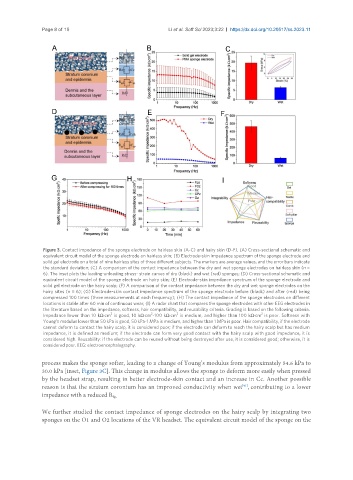
                Figure 3. Contact impedance of the sponge electrode on hairless skin (A-C) and hairy skin (D-F). (A) Cross-sectional schematic and
                equivalent circuit model of the sponge electrode on hairless skin; (B) Electrode-skin impedance spectrum of the sponge electrode and
                solid gel electrode on a total of nine hairless sites of three different subjects. The markers are average values, and the error bars indicate
                the standard deviation; (C) A comparison of the contact impedance between the dry and wet sponge electrodes on hairless skin (n =
                6). The inset plots the loading-unloading stress- strain curves of dry (black) and wet (red) sponges; (D) Cross-sectional schematic and
                equivalent circuit model of the sponge electrode on hairy skin; (E) Electrode-skin impedance spectrum of the sponge electrode and
                solid gel electrode on the hairy scalp; (F) A comparison of the contact impedance between the dry and wet sponge electrodes on the
                hairy sites (n = 6); (G) Electrode-skin contact impedance spectrum of the sponge electrode before (black) and after (red) being
                compressed 100 times (three measurements at each frequency); (H) The contact impedance of the sponge electrodes on different
                locations is stable after 60 min of continuous wear; (I) A radar chart that compares the sponge electrodes with other EEG electrodes in
                the literature based on the impedance, softness, hair compatibility, and reusability criteria. Grading is based on the following criteria.
                                      2             2        2                           2
                Impedance lower than 10 kΩ·cm  is good, 10 kΩ·cm -100 kΩ·cm  is medium, and higher than 100 kΩ·cm  is poor. Softness with
                Young’s modulus lower than 50 kPa is good, 50 kPa-1 MPa is medium, and higher than 1 MPa is poor. Hair compatibility, if the electrode
                cannot deform to contact the hairy scalp, it is considered poor; if the electrode can deform to reach the hairy scalp but has medium
                impedance, it is defined as medium; if the electrode can form very good contact with the hairy scalp with good impedance, it is
                considered high. Reusability: if the electrode can be reused without being destroyed after use, it is considered good; otherwise, it is
                considered poor. EEG: electroencephalography.


               process makes the sponge softer, leading to a change of Young’s modulus from approximately 54.6 kPa to
               30.0 kPa [inset, Figure 3C]. This change in modulus allows the sponge to deform more easily when pressed
               by the headset strap, resulting in better electrode-skin contact and an increase in Cc. Another possible
                                                                                   [41]
               reason is that the stratum coronium has an improved conductivity when wet , contributing to a lower
               impedance with a reduced R Ep.

               We further studied the contact impedance of sponge electrodes on the hairy scalp by integrating two
               sponges on the O1 and O2 locations of the VR headset. The equivalent circuit model of the sponge on the

