


Page 149 - Read Online
P. 149
Page 12 of 15                              Li et al. Soft Sci 2023;3:22  https://dx.doi.org/10.20517/ss.2023.11


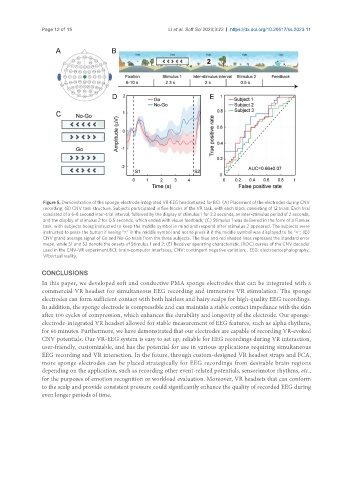
                Figure 5. Demonstration of the sponge-electrode-integrated VR-EEG headset used for BCI. (A) Placement of the electrodes during CNV
                recording; (B) CNV task structure. Subjects participated in five blocks of the VR task, with each block consisting of 12 trials. Each trial
                consisted of a 6-8 second inter-trial interval, followed by the display of stimulus 1 for 2.3 seconds, an inter-stimulus period of 2 seconds,
                and the display of stimulus 2 for 0.5 seconds, which ended with visual feedback; (C) Stimulus 1 was delivered in the form of a Flanker
                task, with subjects being instructed to keep the middle symbol in mind and respond after stimulus 2 appeared. The subjects were
                instructed to press the button if seeing “>” in the middle symbol and not to press it if the middle symbol was displayed to be “<”; (D)
                CNV grand average signal of Go and No-Go trials from the three subjects. The blue and red shaded lines represent the standard error
                mean, while S1 and S2 denote the onsets of Stimulus 1 and 2; (E) Receiver operating characteristic (ROC) curves of the CNV decoder
                used in the CNV-VR experiment.BCI: brain-computer interfaces; CNV: contingent negative variation; . EEG: electroencephalography;
                VR:virtual reality.

               CONCLUSIONS
               In this paper, we developed soft and conductive PMA sponge electrodes that can be integrated with a
               commercial VR headset for simultaneous EEG recording and immersive VR stimulation. The sponge
               electrodes can form sufficient contact with both hairless and hairy scalps for high-quality EEG recordings.
               In addition, the sponge electrode is compressible and can maintain a stable contact impedance with the skin
               after 100 cycles of compression, which enhances the durability and longevity of the electrode. Our sponge-
               electrode-integrated VR headset allowed for stable measurement of EEG features, such as alpha rhythms,
               for 60 minutes. Furthermore, we have demonstrated that our electrodes are capable of recording VR-evoked
               CNV potentials. Our VR-EEG system is easy to set up, reliable for EEG recordings during VR interaction,
               user-friendly, customizable, and has the potential for use in various applications requiring simultaneous
               EEG recording and VR interaction. In the future, through custom-designed VR headset straps and FCA,
               more sponge electrodes can be placed strategically for EEG recordings from desirable brain regions
               depending on the application, such as recording other event-related potentials, sensorimotor rhythms, etc.,
               for the purposes of emotion recognition or workload evaluation. Moreover, VR headsets that can conform
               to the scalp and provide consistent pressure could significantly enhance the quality of recorded EEG during
               even longer periods of time.

