


Page 147 - Read Online
P. 147
Page 10 of 15                              Li et al. Soft Sci 2023;3:22  https://dx.doi.org/10.20517/ss.2023.11

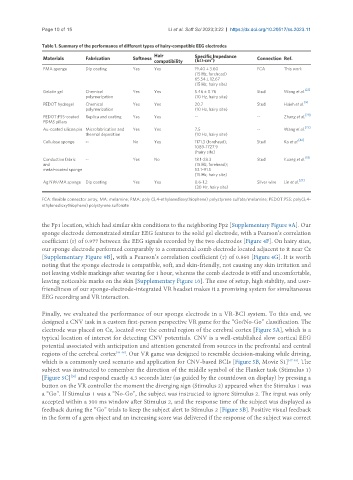
               Table 1. Summary of the performance of different types of hairy-compatible EEG electrodes
                                                     Hair          Specific Impedance
                Materials     Fabrication     Softness                  2               Connection Ref.
                                                     compatibility  (kΩ·cm )
                PMA sponge    Dip coating     Yes    Yes           19.40 ± 3.60         FCA      This work
                                                                   (15 Hz, forehead)
                                                                   65.54 ± 12.67
                                                                   (15 Hz, hairy site)
                Gelatin gel   Chemical        Yes    Yes           5.46 ± 0.76          Stud     Wang et al. [22]
                              polymerization                       (10 Hz, hairy site)
                PEDOT hydrogel  Chemical      Yes    Yes           20.7                 Stud     Hsieh et al. [9]
                              polymerization                       (10 Hz, hairy site)
                                                                                                        [28]
                PEDOT:PSS-coated    Replica and coating  Yes  Yes  --                   --       Zhang et al.
                PDMS pillars
                                                                                                        [23]
                Au-coated silicon pin Microfabrication and    Yes  Yes  7.5             --       Wang et al.
                              thermal deposition                   (10 Hz, hairy site)
                                                                                                      [42]
                Cellulose sponge  --          No     Yes           1171.3 (forehead);   Stud     Ko et al.
                                                                   1089-1727.9
                                                                   (hairy site)
                Conductive fabric   --        Yes    No            18.1-28.3            Stud     Kuang et al. [18]
                and                                                (15 Hz, forehead);
                metal-coated sponge                                53.1-91.5
                                                                   (15 Hz, hairy site)
                                                                                                      [29]
                Ag NW/MA sponge  Dip coating  Yes    Yes           0.6-1.2              Silver wire  Lin et al.
                                                                   (30 Hz, hairy site)
               FCA: flexible connector array; MA: melamine; PMA: poly (3,4-ethylenedioxythiophene) polystyrene sulfate/melamine; PEDOT:PSS: poly(3,4-
               ethylenedioxythiophene) polystyrene sulfonate

               the Fp1 location, which had similar skin conditions to the neighboring Fp2 [Supplementary Figure 9A]. Our
               sponge electrode demonstrated similar EEG features to the solid gel electrode, with a Pearson’s correlation
               coefficient (r) of 0.977 between the EEG signals recorded by the two electrodes [Figure 4F]. On hairy sites,
               our sponge electrode performed comparably to a commercial comb electrode located adjacent to it near Cz
               [Supplementary Figure 9B], with a Pearson’s correlation coefficient (r) of 0.860 [Figure 4G]. It is worth
               noting that the sponge electrode is compatible, soft, and skin-friendly, not causing any skin irritation and
               not leaving visible markings after wearing for 1 hour, whereas the comb electrode is stiff and uncomfortable,
               leaving noticeable marks on the skin [Supplementary Figure 10]. The ease of setup, high stability, and user-
               friendliness of our sponge-electrode-integrated VR headset makes it a promising system for simultaneous
               EEG recording and VR interaction.

               Finally, we evaluated the performance of our sponge electrode in a VR-BCI system. To this end, we
               designed a CNV task in a custom first-person perspective VR game for the “Go/No-Go” classification. The
               electrode was placed on Cz, located over the central region of the cerebral cortex [Figure 5A], which is a
               typical location of interest for detecting CNV potentials. CNV is a well-established slow cortical EEG
               potential associated with anticipation and attention generated from sources in the prefrontal and central
               regions of the cerebral cortex [44-46] . Our VR game was designed to resemble decision-making while driving,
               which is a commonly used scenario and application for CNV-based BCIs [Figure 5B, Movie S1] [47-49] . The
               subject was instructed to remember the direction of the middle symbol of the Flanker task (Stimulus 1)
               [Figure 5C]  and respond exactly 4.3 seconds later (as guided by the countdown on display) by pressing a
                         [50]
               button on the VR controller the moment the diverging sign (Stimulus 2) appeared when the Stimulus 1 was
               a “Go”. If Stimulus 1 was a “No-Go”, the subject was instructed to ignore Stimulus 2. The input was only
               accepted within a 300 ms window after Stimulus 2, and the response time of the subject was displayed as
               feedback during the “Go” trials to keep the subject alert to Stimulus 2 [Figure 5B]. Positive visual feedback
               in the form of a gem object and an increasing score was delivered if the response of the subject was correct

