


Page 12 - Read Online
P. 12
Page 133                 Wang et al. J Transl Genet Genom 2023;7:126-40  https://dx.doi.org/10.20517/jtgg.2023.07


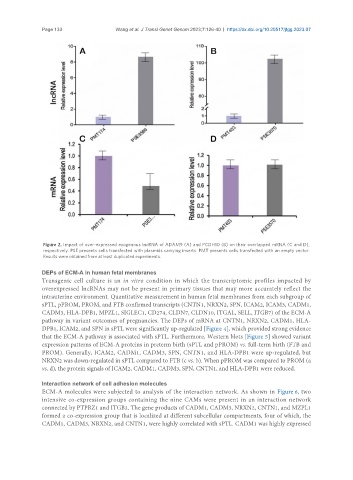
                Figure 2. Impact of over-expressed exogenous lncRNA of ADAM9 (A) and PCDH10 (B) on their overlapped mRNA (C and D),
                respectively. PSE presents cells transfected with plasmids carrying inserts. PMT presents cells transfected with an empty vector.
                Results were obtained from at least duplicated experiments.

               DEPs of ECM-A in human fetal membranes
               Transgenic cell culture is an in vitro condition in which the transcriptomic profiles impacted by
               overexpressed lncRNAs may not be present in primary tissues that may more accurately reflect the
               intrauterine environment. Quantitative measurement in human fetal membranes from each subgroup of
               sPTL, pPROM, PROM, and FTB confirmed transcripts (CNTN1, NRXN2, SPN, ICAM2, ICAM3, CADM1,
               CADM3, HLA-DPB1, MPZL1, SIGLEC1, CD274, CLDN7, CLDN10, ITGAL, SELL, ITGB7) of the ECM-A
               pathway in variant outcomes of pregnancies. The DEPs of mRNA at CNTN1, NRXN2, CADM1, HLA-
               DPB1, ICAM2, and SPN in sPTL were significantly up-regulated [Figure 4], which provided strong evidence
               that the ECM-A pathway is associated with sPTL. Furthermore, Western blots [Figure 5] showed variant
               expression patterns of ECM-A proteins in preterm birth (sPTL and pPROM) vs. full-term birth (FTB and
               PROM). Generally, ICAM2, CADM1, CADM3, SPN, CNTN1, and HLA-DPB1 were up-regulated, but
               NRXN2 was down-regulated in sPTL compared to FTB (c vs. b). When pPROM was compared to PROM (a
               vs. d), the protein signals of ICAM2, CADM1, CADM3, SPN, CNTN1, and HLA-DPB1 were reduced.

               Interaction network of cell adhesion molecules
               ECM-A molecules were subjected to analysis of the interaction network. As shown in Figure 6, two
               intensive co-expression groups containing the nine CAMs were present in an interaction network
               connected by PTPRZ1 and ITGB2. The gene products of CADM1, CADM3, NRXN2, CNTN1, and MZPL1
               formed a co-expression group that is localized at different subcellular compartments, four of which, the
               CADM1, CADM3, NRXN2, and CNTN1, were highly correlated with sPTL. CADM1 was highly expressed

