


Page 81 - Read Online
P. 81
Page 14 of 17                      Cheng et al. J. Mater. Inf. 2025, 5, 53  https://dx.doi.org/10.20517/jmi.2025.61


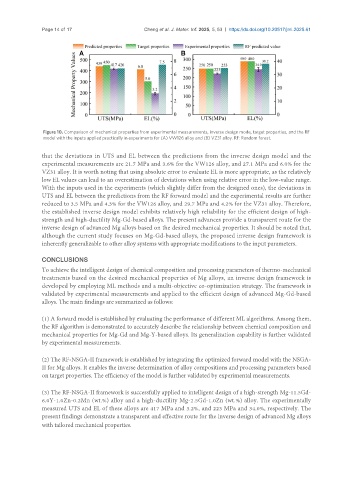
                Figure 10. Comparison of mechanical properties from experimental measurements, inverse design mode, target properties, and the RF
                model with the inputs applied practically in experiments for (A) VW126 alloy and (B) VZ31 alloy. RF: Random forest.

               that the deviations in UTS and EL between the predictions from the inverse design model and the
               experimental measurements are 21.7 MPa and 3.6% for the VW126 alloy, and 27.1 MPa and 6.0% for the
               VZ31 alloy. It is worth noting that using absolute error to evaluate EL is more appropriate, as the relatively
               low EL values can lead to an overestimation of deviations when using relative error in the low-value range.
               With the inputs used in the experiments (which slightly differ from the designed ones), the deviations in
               UTS and EL between the predictions from the RF forward model and the experimental results are further
               reduced to 3.5 MPa and 4.3% for the VW126 alloy, and 29.7 MPa and 4.2% for the VZ31 alloy. Therefore,
               the established inverse design model exhibits relatively high reliability for the efficient design of high-
               strength and high-ductility Mg-Gd-based alloys. The present advances provide a transparent route for the
               inverse design of advanced Mg alloys based on the desired mechanical properties. It should be noted that,
               although the current study focuses on Mg-Gd-based alloys, the proposed inverse design framework is
               inherently generalizable to other alloy systems with appropriate modifications to the input parameters.


               CONCLUSIONS
               To achieve the intelligent design of chemical composition and processing parameters of thermo-mechanical
               treatments based on the desired mechanical properties of Mg alloys, an inverse design framework is
               developed by employing ML methods and a multi-objective co-optimization strategy. The framework is
               validated by experimental measurements and applied to the efficient design of advanced Mg-Gd-based
               alloys. The main findings are summarized as follows:

               (1) A forward model is established by evaluating the performance of different ML algorithms. Among them,
               the RF algorithm is demonstrated to accurately describe the relationship between chemical composition and
               mechanical properties for Mg-Gd and Mg-Y-based alloys. Its generalization capability is further validated
               by experimental measurements.


               (2) The RF-NSGA-II framework is established by integrating the optimized forward model with the NSGA-
               II for Mg alloys. It enables the inverse determination of alloy compositions and processing parameters based
               on target properties. The efficiency of the model is further validated by experimental measurements.


               (3) The RF-NSGA-II framework is successfully applied to intelligent design of a high-strength Mg-11.5Gd-
               6.0Y-1.0Zn-0.2Mn (wt.%) alloy and a high-ductility Mg-2.5Gd-1.0Zn (wt.%) alloy. The experimentally
               measured UTS and EL of these alloys are 417 MPa and 3.2%, and 223 MPa and 34.0%, respectively. The
               present findings demonstrate a transparent and effective route for the inverse design of advanced Mg alloys
               with tailored mechanical properties.

