


Page 85 - Read Online
P. 85
Perspective | Open Access
Journal of Materials
Informatics
Wang et al. J. Mater. Inf. 2026, 6, 1 DOI:10.20517/jmi.2025.41
The synergy of geometric tolerance factor and
machine learning in discovering stable materials
Zhilong Wang 1,2,3 , Fengqi You 1,2,3,*
Keywords:
Materials informatics,
tolerance factor, machine
learning, materials
discovery, stability
assessment
Citation: Wang, Z.; You, F.
The synergy of geometric
tolerance factor and
machine learning in
discovering stable materials.
J. Mater. Inf. 2026, 6, 1. https:
//dx.doi.org/10.20517/jmi.
2025.41
Received: 28 May 2025
First Decision: 3 Jul 2025
Revised: 28 Jul 2025 Abstract
Accepted: 1 Aug 2025
Published: 12 Jan 2026 Assessing stability remains a fundamental prerequisite for deploying materials across a
wide range of applications, including batteries, catalysts, and photovoltaics. However, first-
Academic Editors: principles stability checks such as phonon dispersion and energy above hull calculations
William Yi Wang, Hao Li typically require days to weeks of computing time per composition, creating a critical
Copy Editor:
Pei-Yun Wang bottleneck for truly high-throughput discovery. In this Perspective, we highlight the
Production Editor: underutilized potential of geometric tolerance factors (T f) as lightweight yet informative
Pei-Yun Wang indicators for rapid stability assessment. First, we review the T f developed for
representative materials systems, including perovskites, spinels, and garnets, and analyze
recent cases where such indicators have been integrated into AI-driven materials
discovery. Then, we identify key open challenges in designing T f that are both accurate and
generalizable, as well as in effectively incorporating them into AI frameworks. The potential
solutions, including active learning for multi-composition structure, electron density
profile-based learning for ionic radii estimation, and diffusion model for thermodynamic
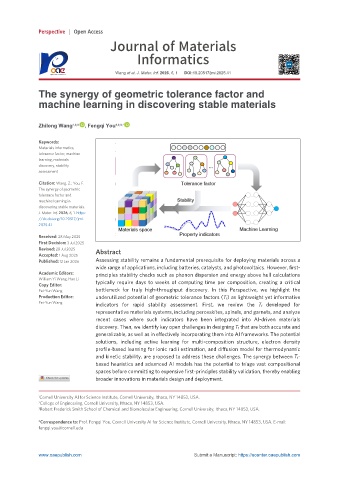
and kinetic stability, are proposed to address these challenges. The synergy between T f-
based heuristics and advanced AI models has the potential to triage vast compositional
spaces before committing to expensive first-principles stability validation, thereby enabling
broader innovations in materials design and deployment.
1 Cornell University AI for Science Institute, Cornell University, Ithaca, NY 14853, USA.
2 College of Engineering, Cornell University, Ithaca, NY 14853, USA.
3 Robert Frederick Smith School of Chemical and Biomolecular Engineering, Cornell University, Ithaca, NY 14853, USA.
* Correspondence to: Prof. Fengqi You, Cornell University AI for Science Institute, Cornell University, Ithaca, NY 14853, USA. E-mail:
fengqi.you@cornell.edu
www.oaepublish.com Submit a Manuscript: https://ucenter.oaepublish.com

