


Page 87 - Read Online
P. 87
Wang et al. J. Mater. Inf. 2026, 6, 1                                              Page 3 of 9


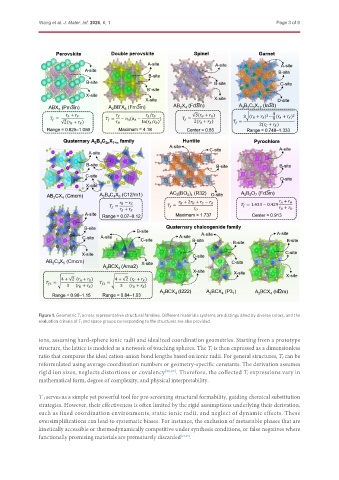
               Figure 1. Geometric T f across representative structural families. Different materials systems are distinguished by diverse colors, and the
               evaluation criteria of T f and space groups corresponding to the structures are also provided.

               ions, assuming hard-sphere ionic radii and idealized coordination geometries. Starting from a prototype
               structure, the lattice is modeled as a network of touching spheres. The T f is then expressed as a dimensionless
               ratio that compares the ideal cation-anion bond lengths based on ionic radii. For general structures, T f can be
               reformulated using average coordination numbers or geometry-specific constants. The derivation assumes
               rigid ion sizes, neglects distortions or covalency [22,23] . Therefore, the collected T f expressions vary in
               mathematical form, degree of complexity, and physical interpretability.


               T  f serves as a simple yet powerful tool for pre-screening structural formability, guiding chemical substitution
               strategies. However, their effectiveness is often limited by the rigid assumptions underlying their derivation,
               such as fixed coordination environments, static ionic radii, and neglect of dynamic effects. These
               oversimplifications can lead to systematic biases. For instance, the exclusion of metastable phases that are
               kinetically accessible or thermodynamically competitive under synthesis conditions, or false negatives where
               functionally promising materials are prematurely discarded [24,25] .

