


Page 86 - Read Online
P. 86
Page 2 of 9                                                       Wang et al. J. Mater. Inf. 2026, 6, 1


               INTRODUCTION
               Predicting the thermodynamic stability remains one of the most fundamental challenges in materials science.
               Stability is not only a prerequisite for synthesizability but also a critical filter before exploring target
               properties such as conductivity, magnetism, or catalytic activity . As generative models, including diffusion
                                                                    [1-3]
               models and large language models, become increasingly central to materials discovery, the ability to generate
               stable candidates has emerged as a core design objective . However, these approaches often lack simple,
                                                               [4-6]
               interpretable, and transferable criteria that can guide generation toward chemically and geometrically
               feasible regions of the compositional space.

               This gap highlights the renewed relevance of tolerance factors (T f), which provide a geometric measure of
               structural stability for a given composition. Initially formulated for perovskite materials , the concept has
                                                                                          [7,8]
               since been generalized to other families, such as spinels , garnets [10,11] , and quaternary compounds [12,13] , where
                                                             [9]
               packing efficiency and ionic size compatibility govern the formation and stability of crystal structures. T f has
               the appeal of physical interpretability and computational efficiency, making it ideal for rapid screening.
               However, despite its simplicity and relevance, T f has not been fully integrated into modern AI-driven
               materials pipelines. The challenge lies in how to embed such universal structural priors into generative or
               predictive models in a flexible way, leading to realizable materials. For example, generative models guided by
               geometric constraints or reinforced by structural stability feedback from density functional theory (DFT) or
               ab initio molecular dynamics (AIMD) simulations can potentially learn to discover novel but stable
               geometries [14,15] , extending the scope of materials far beyond canonical design spaces [16,17] .


               Despite the historical significance, T f has received limited attention in the broader landscape of AI-driven
               materials discovery. To date, its application has been largely confined to a few prototypical systems, many
               other materials exhibiting similar geometric correlations remain underexplored. Here, we aim to fill this gap
               by summarizing the T f frameworks used in representative systems, and demonstrating how T f can be
               integrated into AI-based materials pipelines. Finally, we articulate key challenges that need to be addressed to
               generalize T f across broader domains, and propose potential solutions. Together, these strategies suggest a
               promising route toward discovering stable materials more efficiently, with T f serving as lightweight yet
               informative guide in the design space.


               GEOMETRIC TOLERANCE FACTORS FOR REPRESENTATIVE MATERIALS SYSTEMS
               The concept of the T f originated from geometric considerations of ionic packing in perovskite structures .
                                                                                                        [7,8]
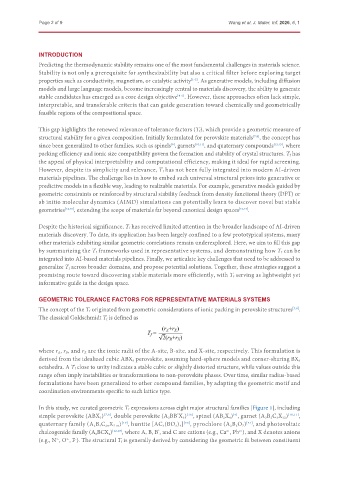
               The classical Goldschmidt T f is defined as


               where r A, r B, and r X are the ionic radii of the A-site, B-site, and X-site, respectively. This formulation is
               derived from the idealized cubic ABX 3 perovskite, assuming hard-sphere models and corner-sharing BX 6
               octahedra. A T f close to unity indicates a stable cubic or slightly distorted structure, while values outside this
               range often imply instabilities or transformations to non-perovskite phases. Over time, similar radius-based
               formulations have been generalized to other compound families, by adapting the geometric motif and
               coordination environments specific to each lattice type.

               In this study, we curated geometric T f expressions across eight major structural families [Figure 1], including
               simple perovskite (ABX 3) [7,8] , double perovskite (A 2BB’X 6) , spinel (AB 2X 4) , garnet (A 3B 2C 3X 12) [10,11] ,
                                                                                   [9]
                                                                   [18]
               quaternary family (A 2B 4C 2nX 7+n) , huntite [AC 3(BO 3) 4] , pyrochlore (A 2B 2O 7) , and photovoltaic
                                                                  [20]
                                                                                        [21]
                                            [19]
               chalcogenide family (A 2BCX 4) [12,13] , where A, B, B’, and C are cations (e.g., Ca , Pb ), and X denotes anions
                                                                                 2+
                                                                                     2+
               (e.g., N , O , F ). The structural T f is generally derived by considering the geometric fit between constituent
                     3-
                        2-
                           -

