


Page 78 - Read Online
P. 78
Cheng et al. J. Mater. Inf. 2025, 5, 53  https://dx.doi.org/10.20517/jmi.2025.61  Page 11 of 17

               Table 4. The predicted composition and processing parameters from the RF-NSGA inverse design model
                         Composition (wt.%)     Processing parameters       Predicted          Target
                Alloy
                       Gd   Y    Zn   Mn   ST (°C)  St (h)  ET (°C)  ER  UTS/MPa  EL/%   UTS/MPa    EL/%
                Alloy 1  11.0  5.8  1.1  0.1  515   16     455     10  400.3      5.1    400        5
                Alloy 2  2.4  0.0  1.5  0.0  490    20     400     22  250.1      19.1   250        20
               RF: Random forest; NSGA: non-dominated sorting genetic algorithm; ST: solid solution temperature; St: solid solution time; ET: extrusion
               temperature; ER: extrusion ratio; UTS: ultimate tensile strength; EL: elongation.


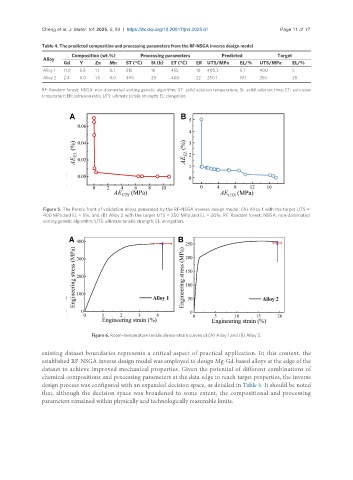
                Figure 5. The Pareto front of validation alloys generated by the RF-NSGA inverse design model: (A) Alloy 1 with the target UTS =
                400 MPa and EL = 5%; and (B) Alloy 2 with the target UTS = 250 MPa and EL = 20%. RF: Random forest; NSGA: non-dominated
                sorting genetic algorithm; UTS: ultimate tensile strength; EL: elongation.


                                Figure 6. Room-temperature tensile stress-strain curves of (A) Alloy 1 and (B) Alloy 2.


               existing dataset boundaries represents a critical aspect of practical application. In this context, the
               established RF-NSGA inverse design model was employed to design Mg-Gd-based alloys at the edge of the
               dataset to achieve improved mechanical properties. Given the potential of different combinations of
               chemical compositions and processing parameters at the data edge to reach target properties, the inverse
               design process was configured with an expanded decision space, as detailed in Table 5. It should be noted
               that, although the decision space was broadened to some extent, the compositional and processing
               parameters remained within physically and technologically reasonable limits.

