


Page 248 - Read Online
P. 248
Liu et al. J. Mater. Inf. 2026, 6, 18                                            Page 13 of 29


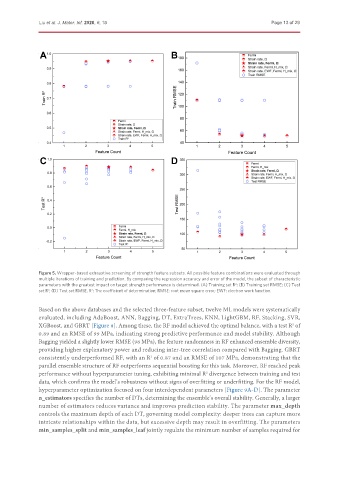
               Figure 5. Wrapper-based exhaustive screening of strength feature subsets. All possible feature combinations were evaluated through
               multiple iterations of training and prediction. By comparing the regression accuracy and error of the model, the subset of characteristic
               parameters with the greatest impact on target strength performance is determined. (A) Training set R ; (B) Training set RMSE; (C) Test
                                                                                    2
               set R ; (D) Test set RMSE. R : The coefficient of determination; RMSE: root mean square error; EWF: electron work function.
                                 2
                  2
               Based on the above databases and the selected three-feature subset, twelve ML models were systematically
               evaluated, including AdaBoost, ANN, Bagging, DT, ExtraTrees, KNN, LightGBM, RF, Stacking, SVR,
               XGBoost, and GBRT [Figure 8]. Among these, the RF model achieved the optimal balance, with a test R  of
                                                                                                        2
               0.89 and an RMSE of 99 MPa, indicating strong predictive performance and model stability. Although
               Bagging yielded a slightly lower RMSE (98 MPa), the feature randomness in RF enhanced ensemble diversity,
               providing higher explanatory power and reducing inter-tree correlation compared with Bagging. GBRT
               consistently underperformed RF, with an R  of 0.87 and an RMSE of 107 MPa, demonstrating that the
                                                      2
               parallel ensemble structure of RF outperforms sequential boosting for this task. Moreover, RF reached peak
               performance without hyperparameter tuning, exhibiting minimal R  divergence between training and test
                                                                         2
               data, which confirms the model’s robustness without signs of overfitting or underfitting. For the RF model,
               hyperparameter optimization focused on four interdependent parameters [Figure 9A-D]. The parameter
               n_estimators specifies the number of DTs, determining the ensemble’s overall stability. Generally, a larger
               number of estimators reduces variance and improves prediction stability. The parameter max_depth
               controls the maximum depth of each DT, governing model complexity: deeper trees can capture more
               intricate relationships within the data, but excessive depth may result in overfitting. The parameters
               min_samples_split and min_samples_leaf jointly regulate the minimum number of samples required for

