


Page 244 - Read Online
P. 244
Liu et al. J. Mater. Inf. 2026, 6, 18                                             Page 9 of 29


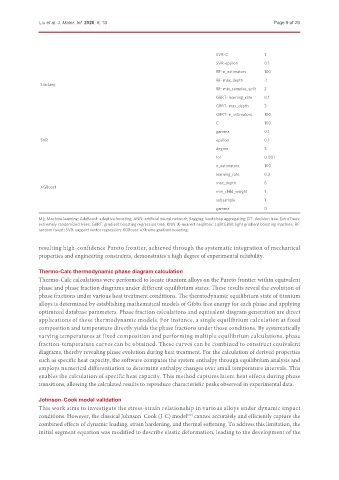
                                                                             SVR-C            1
                                                                             SVR-epsilon      0.1
                                                                             RF- n_estimators  100
                                                                             RF- max_depth    -1
               Stacking
                                                                             RF- min_samples_split  2
                                                                             GBRT- learning_rate  0.1
                                                                             GBRT- max_depth  3
                                                                             GBRT- n_estimators  100
                                                                             C                100
                                                                             gamma            0.1
               SVR                                                           epsilon          0.1
                                                                             degree           3
                                                                             tol              0.001
                                                                             n_estimators     100
                                                                             learning_rate    0.3
                                                                             max_depth        6
               XGBoost
                                                                             min_child_weight  1
                                                                             subsample        1
                                                                             gamma            0
               ML: Machine learning; AdaBoost: adaptive boosting; ANN: artificial neural network; Bagging: bootstrap aggregating; DT: decision tree; ExtraTrees:
               extremely randomized trees; GBRT: gradient boosting regression tree; KNN: K-nearest neighbor; LightGBM: light gradient boosting machine; RF:
               random forest; SVR: support vector regression; XGBoost: eXtreme gradient boosting.

               resulting high-confidence Pareto frontier, achieved through the systematic integration of mechanical
               properties and engineering constraints, demonstrates a high degree of experimental reliability.


               Thermo-Calc thermodynamic phase diagram calculation
               Thermo-Calc calculations were performed to locate titanium alloys on the Pareto frontier within equivalent
               phase and phase fraction diagrams under different equilibrium states. These results reveal the evolution of
               phase fractions under various heat treatment conditions. The thermodynamic equilibrium state of titanium
               alloys is determined by establishing mathematical models of Gibbs free energy for each phase and applying
               optimized database parameters. Phase fraction calculations and equivalent diagram generation are direct
               applications of these thermodynamic models. For instance, a single equilibrium calculation at fixed
               composition and temperature directly yields the phase fractions under those conditions. By systematically
               varying temperatures at fixed composition and performing multiple equilibrium calculations, phase
               fraction-temperature curves can be obtained. These curves can be combined to construct equivalent
               diagrams, thereby revealing phase evolution during heat treatment. For the calculation of derived properties
               such as specific heat capacity, the software computes the system enthalpy through equilibrium analysis and
               employs numerical differentiation to determine enthalpy changes over small temperature intervals. This
               enables the calculation of specific heat capacity. This method captures latent heat effects during phase
               transitions, allowing the calculated results to reproduce characteristic peaks observed in experimental data.


               Johnson–Cook model validation
               This work aims to investigate the stress-strain relationship in various alloys under dynamic impact
               conditions. However, the classical Johnson–Cook (J–C) model  cannot accurately and efficiently capture the
                                                                   [69]
               combined effects of dynamic loading, strain hardening, and thermal softening. To address this limitation, the
               initial segment equation was modified to describe elastic deformation, leading to the development of the

