


Page 18 - Read Online
P. 18
Page 12 of 17                    Schertzer et al. J. Mater. Inf. 2025, 5, 5  https://dx.doi.org/10.20517/jmi.2024.69


                                               -
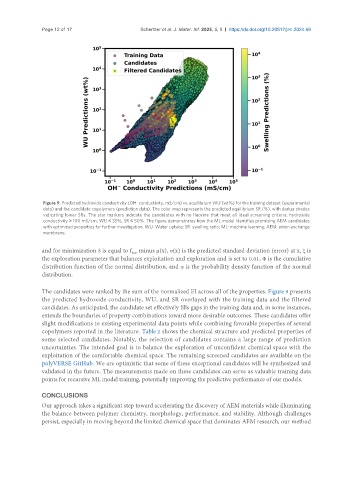
                Figure 9. Predicted hydroxide conductivity (OH  conductivity, mS/cm) vs. equilibrium WU (wt%) for the training dataset (experimental
                data) and the candidate copolymers (prediction data). The color map represents the predicted equilibrium SR (%), with darker shades
                indicating lower SRs. The star markers indicate the candidates with no fluorine that meet all ideal screening criteria: hydroxide
                conductivity ≥ 100 mS/cm, WU ≤ 35%, SR ≤ 50%. The figure demonstrates how the ML model identifies promising AEM candidates
                with optimized properties for further investigation. WU: Water uptake; SR: swelling ratio; ML: machine learning; AEM: anion exchange
                membrane.

               and for minimization δ is equal to f  minus µ(x), σ(x) is the predicted standard deviation (error) at x, ξ is
                                             best
               the exploration parameter that balances exploitation and exploration and is set to 0.01, Φ is the cumulative
               distribution function of the normal distribution, and φ is the probability density function of the normal
               distribution.

               The candidates were ranked by the sum of the normalized EI across all of the properties. Figure 9 presents
               the predicted hydroxide conductivity, WU, and SR overlayed with the training data and the filtered
               candidates. As anticipated, the candidate set effectively fills gaps in the training data and, in some instances,
               extends the boundaries of property combinations toward more desirable outcomes. These candidates offer
               slight modifications to existing experimental data points while combining favorable properties of several
               copolymers reported in the literature. Table 2 shows the chemical structure and predicted properties of
               some selected candidates. Notably, the selection of candidates contains a large range of prediction
               uncertainties. The intended goal is to balance the exploration of unconfident chemical space with the
               exploitation of the comfortable chemical space. The remaining screened candidates are available on the
               polyVERSE GitHub. We are optimistic that some of these exceptional candidates will be synthesized and
               validated in the future. The measurements made on these candidates can serve as valuable training data
               points for recursive ML model training, potentially improving the predictive performance of our models.


               CONCLUSIONS
               Our approach takes a significant step toward accelerating the discovery of AEM materials while illuminating
               the balance between polymer chemistry, morphology, performance, and stability. Although challenges
               persist, especially in moving beyond the limited chemical space that dominates AEM research, our method

