


Page 20 - Read Online
P. 20
Page 14 of 17                                                               Schertzer et al. J. Mater. Inf. 2025, 5, 5  https://dx.doi.org/10.20517/jmi.2024.69

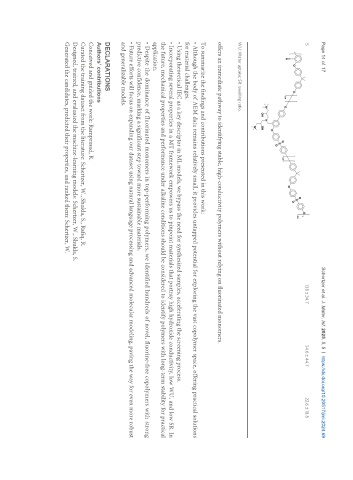
                5                                                                                138 ± 34.7          34.6 ± 44.7       22.6 ± 18.8


               WU: Water uptake; SR: swelling ratio.

               offers an immediate pathway to identifying stable, high-conductivity polymers without relying on fluorinated monomers.


               To summarize the findings and contributions presented in this work:
               • Although the body of AEM data remains relatively small, it provides untapped potential for exploring the vast copolymer space, offering practical solutions
               for material challenges.
               • Using theoretical IEC as a key descriptor in ML models, we bypass the need for synthesized samples, accelerating the screening process.
               • Incorporating several properties in a MT framework empowers us to pinpoint materials that portray high hydroxide conductivity, low WU, and low SR. In
               the future, mechanical properties and performance under alkaline conditions should be considered to identify polymers with long-term stability for practical
               application.
               • Despite the dominance of fluorinated monomers in top-performing polymers, we identified hundreds of novel, fluorine-free copolymers with strong
               predictive confidence, marking a significant step toward more sustainable materials.
               • Future efforts will focus on expanding our dataset using natural language processing and advanced molecular modeling, paving the way for even more robust
               and generalizable models.

               DECLARATIONS
               Authors’ contributions
               Conceived and guided the work: Ramprasad, R.
               Curated the training dataset from the literature: Schertzer, W., Shukla, S., Rafiq, R.
               Designed, trained, and evaluated the machine-learning models: Schertzer, W., Shukla, S.
               Generated the candidates, predicted their properties, and ranked them: Schertzer, W.

