


Page 87 - Read Online
P. 87
Gesch et al. J. Mater. Inf. 2025, 5, 42  https://dx.doi.org/10.20517/jmi.2025.23  Page 9 of 20


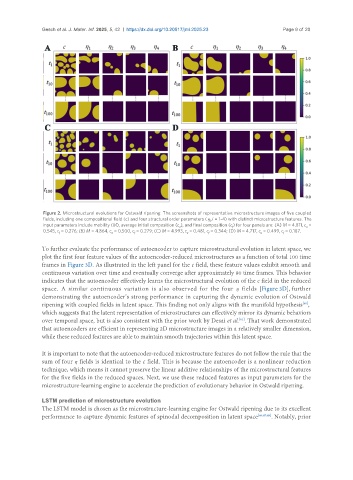
                Figure 2. Microstructural evolutions for Ostwald ripening. The screenshots of representative microstructure images of five coupled
                fields, including one compositional field (c) and four structural order parameters (η, i = 1-4) with distinct microstructure features. The
                                                                        i
                input parameters include mobility (M), average initial composition (c ), and final composition (c ) for four panels are: (A) M = 4.811, c  =
                                                             a                 f                        a
                0.545, c  = 0.276; (B) M = 4.864, c  = 0.500, c  = 0.279; (C) M = 4.993, c  = 0.481, c  = 0.344; (D) M = 4.717, c  = 0.499, c  = 0.187.
                     f                 a      f                 a      f                 a       f
               To further evaluate the performance of autoencoder to capture microstructural evolution in latent space, we
               plot the first four feature values of the autoencoder-reduced microstructures as a function of total 100 time
               frames in Figure 3D. As illustrated in the left panel for the c field, these feature values exhibit smooth and
               continuous variation over time and eventually converge after approximately 80 time frames. This behavior
               indicates that the autoencoder effectively learns the microstructural evolution of the c field in the reduced
               space.  A  similar  continuous  variation  is  also  observed  for  the  four  η  fields  [Figure 3D], further
               demonstrating the autoencoder’s strong performance in capturing the dynamic evolution of Ostwald
               ripening with coupled fields in latent space. This finding not only aligns with the manifold hypothesis ,
                                                                                                       [60]
               which suggests that the latent representation of microstructures can effectively mirror its dynamic behaviors
               over temporal space, but is also consistent with the prior work by Desai et al. . That work demonstrated
                                                                                  [61]
               that autoencoders are efficient in representing 2D microstructure images in a relatively smaller dimension,
               while these reduced features are able to maintain smooth trajectories within this latent space.


               It is important to note that the autoencoder-reduced microstructure features do not follow the rule that the
               sum of four η fields is identical to the c field. This is because the autoencoder is a nonlinear reduction
               technique, which means it cannot preserve the linear additive relationships of the microstructural features
               for the five fields in the reduced spaces. Next, we use these reduced features as input parameters for the
               microstructure-learning engine to accelerate the prediction of evolutionary behavior in Ostwald ripening.


               LSTM prediction of microstructure evolution
               The LSTM model is chosen as the microstructure-learning engine for Ostwald ripening due to its excellent
               performance to capture dynamic features of spinodal decomposition in latent space [46,47,49] . Notably, prior

