


Page 16 - Read Online
P. 16
Liu et al. J Mater Inf 2024;4:33  https://dx.doi.org/10.20517/jmi.2024.48        Page 9 of 33


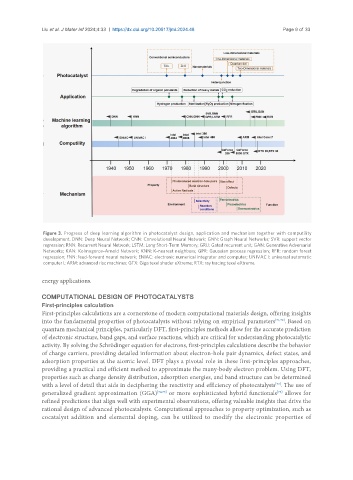
                Figure 3. Progress of deep learning algorithm in photocatalyst design, application and mechanism together with computility
                development. DNN: Deep Neural Network; CNN: Convolutional Neural Network; GNN: Graph Neural Networks; SVR: support vector
                regression; RNN: Recurrent Neural Network; LSTM: Long Short-Term Memory; GRU: Gated recurrent unit; GAN: Generative Adversarial
                Networks; KAN: Kolmogorov-Arnold Network; KNN: K-nearest neighbors; GPR: Gaussian process regression; RFR: random forest
                regression; FNN: feed-forward neural network; ENIAC: electronic numerical integrator and computer; UNIVAC I: universal automatic
                computer I; ARM: advanced risc machines; GTX: Giga texel shader eXtreme; RTX: ray tracing texel eXtreme.

               energy applications.


               COMPUTATIONAL DESIGN OF PHOTOCATALYSTS
               First-principles calculation
               First-principles calculations are a cornerstone of modern computational materials design, offering insights
               into the fundamental properties of photocatalysts without relying on empirical parameters [71,72] . Based on
               quantum mechanical principles, particularly DFT, first-principles methods allow for the accurate prediction
               of electronic structure, band gaps, and surface reactions, which are critical for understanding photocatalytic
               activity. By solving the Schrödinger equation for electrons, first-principles calculations describe the behavior
               of charge carriers, providing detailed information about electron-hole pair dynamics, defect states, and
               adsorption properties at the atomic level. DFT plays a pivotal role in these first-principles approaches,
               providing a practical and efficient method to approximate the many-body electron problem. Using DFT,
               properties such as charge density distribution, adsorption energies, and band structure can be determined
               with a level of detail that aids in deciphering the reactivity and efficiency of photocatalysts . The use of
                                                                                              [73]
               generalized gradient approximation (GGA) [74,75]  or more sophisticated hybrid functionals  allows for
                                                                                              [76]
               refined predictions that align well with experimental observations, offering valuable insights that drive the
               rational design of advanced photocatalysts. Computational approaches to property optimization, such as
               cocatalyst addition and elemental doping, can be utilized to modify the electronic properties of

