


Page 12 - Read Online
P. 12
Liu et al. J Mater Inf 2024;4:33  https://dx.doi.org/10.20517/jmi.2024.48        Page 5 of 33

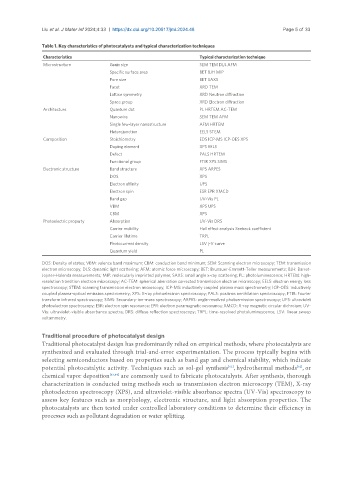
               Table 1. Key characteristics of photocatalysts and typical characterization techniques
                Characteristics                                     Typical characterization technique
                Microstructure        Grain size                    SEM TEM DLS AFM
                                      Specific surface area         BET BJH MIP
                                      Pore size                     BET SAXS
                                      Facet                         XRD TEM
                                      Lattice symmetry              XRD Neutron diffraction
                                      Space group                   XRD Electron diffraction
                Architecture          Quantum dot                   PL HRTEM AC-TEM
                                      Nanowire                      SEM TEM AFM
                                      Single few-layer nanostructure  AFM HRTEM
                                      Heterojunction                EELS STEM
                Composition           Stoichiometry                 EDS ICP-MS ICP-OES XPS
                                      Doping element                XPS EELS
                                      Defect                        PALS HRTEM
                                      Functional group              FTIR XPS SIMS
                Electronic structure  Band structure                XPS ARPES
                                      DOS                           XPS
                                      Electron affinity             UPS
                                      Electron spin                 ESR EPR XMCD
                                      Band gap                      UV-Vis PL
                                      VBM                           XPS UPS
                                      CBM                           XPS
                Photoelectric property  Absorption                  UV-Vis DRS
                                      Carrier mobility              Hall effect analysis Seebeck coefficient
                                      Carrier lifetime              TRPL
                                      Photocurrent density          LSV j-V curve
                                      Quantum yield                 PL

               DOS: Density of states; VBM: valence band maximum; CBM: conduction band minimum; SEM: Scanning electron microscopy; TEM: transmission
               electron microscopy; DLS: dynamic light scattering; AFM: atomic force microscopy; BET: Brunauer-Emmett-Teller measurements; BJH: Barret-
               Joyner-Halenda measurements; MIP: molecularly imprinted polymer; SAXS: small angle x-ray scattering; PL: photoluminescence; HRTEM: high-
               resolution transition electron microscopy; AC-TEM: spherical aberration corrected transmission electron microscopy; EELS: electron energy loss
               spectroscopy; STEM: scanning transmission electron microscopy; ICP-MS: inductively coupled plasma mass spectrometry; ICP-OES: inductively
               coupled plasma-optical emission spectrometry; XPS: X-ray photoelectron spectroscopy; PALS: positron annihilation spectroscopy; FTIR: Fourier
               transform infrared spectroscopy; SIMS: Secondary-ion-mass spectroscopy; ARPES: angle-resolved photoemission spectroscopy; UPS: ultraviolet
               photoelectron spectroscopy; ESR: electron spin resonance; EPR: electron paramagnetic resonance; XMCD: X-ray magnetic circular dichroism; UV-
               Vis: ultraviolet-visible absorbance spectra; DRS: diffuse reflection spectroscopy; TRPL: time-resolved photoluminescence; LSV: linear sweep
               voltammetry.


               Traditional procedure of photocatalyst design
               Traditional photocatalyst design has predominantly relied on empirical methods, where photocatalysts are
               synthesized and evaluated through trial-and-error experimentation. The process typically begins with
               selecting semiconductors based on properties such as band gap and chemical stability, which indicate
               potential photocatalytic activity. Techniques such as sol-gel synthesis , hydrothermal methods , or
                                                                              [61]
                                                                                                     [62]
               chemical vapor deposition [63,64]  are commonly used to fabricate photocatalysts. After synthesis, thorough
               characterization is conducted using methods such as transmission electron microscopy (TEM), X-ray
               photoelectron spectroscopy (XPS), and ultraviolet-visible absorbance spectra (UV-Vis) spectroscopy to
               assess key features such as morphology, electronic structure, and light absorption properties. The
               photocatalysts are then tested under controlled laboratory conditions to determine their efficiency in
               processes such as pollutant degradation or water splitting.

