


Page 15 - Read Online
P. 15
Page 8 of 33                           Liu et al. J Mater Inf 2024;4:33  https://dx.doi.org/10.20517/jmi.2024.48

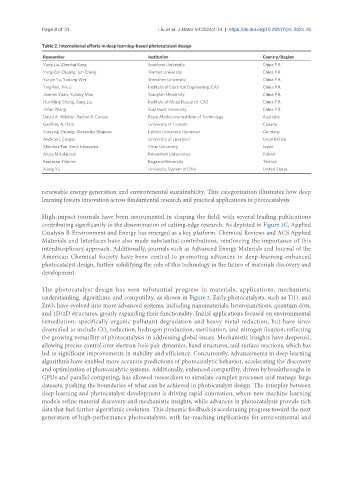
               Table 2. International efforts in deep learning-based photocatalyst design
                Researcher                         Institution                            Country/Region
                Yang Liu, Zhenhui Kang             Soochow University                     China P.R.
                Yong-Bin Zhuang, Jun Cheng         Xiamen University                      China P.R.
                Yunjin Yu, Yadong Wei              Shenzhen University                    China P.R.
                Ting Ren, Xin Li                   Institute of Electrical Engineering, CAS  China P.R.
                Jianmei Yuan, Yuliang Mao          Xiangtan University                    China P.R.
                Hui-Ming Cheng, Gang Liu           Institute of Metal Research, CAS       China P.R.
                Jinlan Wang                        Southeast University                   China P.R.
                David A. Winkler, Rachel A. Caruso  Royal Melbourne Institute of Technology  Australia
                Geoffrey A. Ozin                   University of Toronto                  Canada
                Xiaoying Zhuang, Alexander Shapeev  Leibniz University Hannover           Germany
                Andrew I. Cooper                   University of Liverpool                Great Britain
                Zhenhua Pan, Kenji Katayama        Chuo University                        Japan
                Alicja Mikolajczyk                 Fahrenheit Universities                Poland
                Ramazan Yildirim                   Bogazici University                    Türkiye
                Xiong Yu                           University System of Ohio              United States


               renewable energy generation and environmental sustainability. This categorization illustrates how deep
               learning fosters innovation across fundamental research and practical applications in photocatalysis.


               High-impact journals have been instrumental in shaping the field, with several leading publications
               contributing significantly to the dissemination of cutting-edge research. As depicted in Figure 2C, Applied
               Catalysis B-Environment and Energy has emerged as a key platform. Chemical Reviews and ACS Applied
               Materials and Interfaces have also made substantial contributions, reinforcing the importance of this
               interdisciplinary approach. Additionally, journals such as Advanced Energy Materials and Journal of the
               American Chemical Society have been central to promoting advances in deep-learning-enhanced
               photocatalyst design, further solidifying the role of this technology in the future of materials discovery and
               development.


               The  photocatalyst  design  has  seen  substantial  progress  in  materials,  applications,  mechanistic
               understanding, algorithms, and computility, as shown in Figure 3. Early photocatalysts, such as TiO  and
                                                                                                      2
               ZnO, have evolved into more advanced systems, including nanomaterials, heterojunctions, quantum dots,
               and 1D/2D structures, greatly expanding their functionality. Initial applications focused on environmental
               remediation, specifically organic pollutant degradation and heavy metal reduction, but have since
               diversified to include CO  reduction, hydrogen production, sterilization, and nitrogen fixation, reflecting
                                     2
               the growing versatility of photocatalysis in addressing global issues. Mechanistic insights have deepened,
               allowing precise control over electron-hole pair dynamics, band structures, and surface reactions, which has
               led to significant improvements in stability and efficiency. Concurrently, advancements in deep learning
               algorithms have enabled more accurate predictions of photocatalytic behavior, accelerating the discovery
               and optimization of photocatalytic systems. Additionally, enhanced computility, driven by breakthroughs in
               GPUs and parallel computing, has allowed researchers to simulate complex processes and manage large
               datasets, pushing the boundaries of what can be achieved in photocatalyst design. The interplay between
               deep learning and photocatalyst development is driving rapid innovation, where new machine learning
               models refine material discovery and mechanistic insights, while advances in photocatalysis provide rich
               data that fuel further algorithmic evolution. This dynamic feedback is accelerating progress toward the next
               generation of high-performance photocatalysts, with far-reaching implications for environmental and

