


Page 14 - Read Online
P. 14
Liu et al. J Mater Inf 2024;4:33  https://dx.doi.org/10.20517/jmi.2024.48        Page 7 of 33


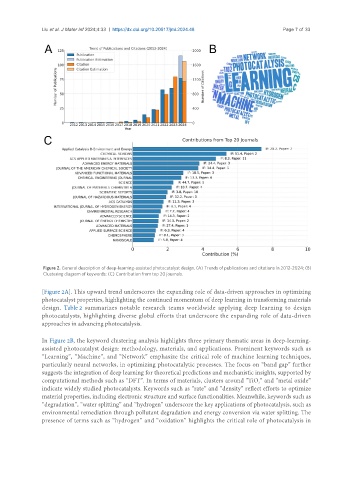
                Figure 2. General description of deep-learning-assisted photocatalyst design. (A) Trends of publications and citations in 2012-2024; (B)
                Clustering diagram of keywords; (C) Contribution from top 20 journals.


               [Figure 2A]. This upward trend underscores the expanding role of data-driven approaches in optimizing
               photocatalyst properties, highlighting the continued momentum of deep learning in transforming materials
               design. Table 2 summarizes notable research teams worldwide applying deep learning to design
               photocatalysts, highlighting diverse global efforts that underscore the expanding role of data-driven
               approaches in advancing photocatalysis.


               In Figure 2B, the keyword clustering analysis highlights three primary thematic areas in deep-learning-
               assisted photocatalyst design: methodology, materials, and applications. Prominent keywords such as
               “Learning”, “Machine”, and “Network” emphasize the critical role of machine learning techniques,
               particularly neural networks, in optimizing photocatalytic processes. The focus on “band gap” further
               suggests the integration of deep learning for theoretical predictions and mechanistic insights, supported by
               computational methods such as “DFT”. In terms of materials, clusters around “TiO ” and “metal oxide”
                                                                                        2
               indicate widely studied photocatalysts. Keywords such as “rate” and “density” reflect efforts to optimize
               material properties, including electronic structure and surface functionalities. Meanwhile, keywords such as
               “degradation”, “water splitting” and “hydrogen” underscore the key applications of photocatalysis, such as
               environmental remediation through pollutant degradation and energy conversion via water splitting. The
               presence of terms such as “hydrogen” and “oxidation” highlights the critical role of photocatalysis in

