


Page 19 - Read Online
P. 19
Page 12 of 33                          Liu et al. J Mater Inf 2024;4:33  https://dx.doi.org/10.20517/jmi.2024.48


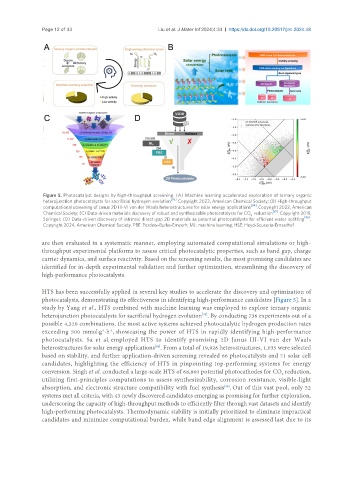
                Figure 5. Photocatalyst designs by high-throughput screening. (A) Machine learning accelerated exploration of ternary organic
                                                           [93]
                heterojunction photocatalysts for sacrificial hydrogen  evolution  . Copyright 2023, American Chemical Society; (B) High-throughput
                                                                                      [94]
                computational screening of Janus 2D III-VI van der Waals heterostructures for solar energy applications  . Copyright 2022, American
                                                                                             [95]
                Chemical Society; (C) Data-driven materials discovery of robust and synthesizable photocatalysts for CO  reduction  . Copyright 2019,
                                                                                      2
                                                                                                        [96]
                Springer; (D) Data-driven discovery of intrinsic direct-gap 2D materials as potential photocatalysts for efficient water  splitting  .
                Copyright 2024, American Chemical Society. PBE: Perdew-Burke-Ernzerh; ML: machine learning; HSE: Heyd-Scuseria-Ernzerhof.
               are then evaluated in a systematic manner, employing automated computational simulations or high-
               throughput experimental platforms to assess critical photocatalytic properties, such as band gap, charge
               carrier dynamics, and surface reactivity. Based on the screening results, the most promising candidates are
               identified for in-depth experimental validation and further optimization, streamlining the discovery of
               high-performance photocatalysts.


               HTS has been successfully applied in several key studies to accelerate the discovery and optimization of
               photocatalysts, demonstrating its effectiveness in identifying high-performance candidates [Figure 5]. In a
               study by Yang et al., HTS combined with machine learning was employed to explore ternary organic
               heterojunction photocatalysts for sacrificial hydrogen evolution . By conducting 736 experiments out of a
                                                                     [93]
               possible 4,320 combinations, the most active systems achieved photocatalytic hydrogen production rates
                                   -1
               exceeding 500 mmol·g ·h , showcasing the power of HTS in rapidly identifying high-performance
                                      -1
               photocatalysts.  Sa  et  al. employed  HTS  to  identify  promising  2D  Janus  III-VI  van  der  Waals
                                                     [94]
               heterostructures for solar energy applications . From a total of 19,926 heterostructures, 1,035 were selected
               based on stability, and further application-driven screening revealed 66 photocatalysts and 71 solar cell
               candidates, highlighting the efficiency of HTS in pinpointing top-performing systems for energy
               conversion. Singh et al. conducted a large-scale HTS of 68,860 potential photocathodes for CO  reduction,
                                                                                                2
               utilizing first-principles computations to assess synthesizability, corrosion resistance, visible-light
                                                                             [95]
               absorption, and electronic structure compatibility with fuel synthesis . Out of this vast pool, only 52
               systems met all criteria, with 43 newly discovered candidates emerging as promising for further exploration,
               underscoring the capacity of high-throughput methods to efficiently filter through vast datasets and identify
               high-performing photocatalysts. Thermodynamic stability is initially prioritized to eliminate impractical
               candidates and minimize computational burden, while band edge alignment is assessed last due to its

