


Page 116 - Read Online
P. 116
Shang et al. J. Mater. Inf. 2025, 5, 52  https://dx.doi.org/10.20517/jmi.2025.36  Page 9 of 15


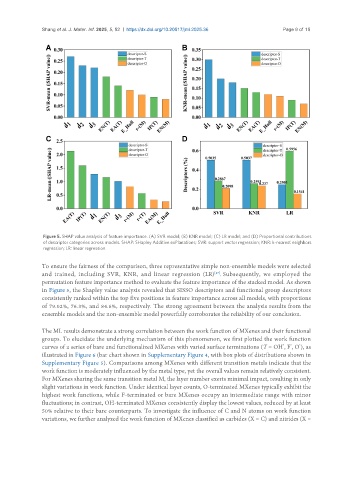
                Figure 5. SHAP value analysis of feature importance. (A) SVR model; (B) KNR model; (C) LR model; and (D) Proportional contributions
                of descriptor categories across models. SHAP: SHapley Additive exPlanations; SVR: support vector regression; KNR: k-nearest neighbors
                regression; LR: linear regression.

               To ensure the fairness of the comparison, three representative simple non-ensemble models were selected
                                                                         [47]
               and trained, including SVR, KNR, and linear regression (LR) . Subsequently, we employed the
               permutation feature importance method to evaluate the feature importance of the stacked model. As shown
               in Figure 5, the Shapley value analysis revealed that SISSO descriptors and functional group descriptors
               consistently ranked within the top five positions in feature importance across all models, with proportions
               of 79.02%, 76.3%, and 84.6%, respectively. The strong agreement between the analysis results from the
               ensemble models and the non-ensemble model powerfully corroborates the reliability of our conclusion.


               The ML results demonstrate a strong correlation between the work function of MXenes and their functional
               groups. To elucidate the underlying mechanism of this phenomenon, we first plotted the work function
               curves of a series of bare and functionalized MXenes with varied surface terminations (T = OH , F , O ), as
                                                                                                *
                                                                                                      *
                                                                                                   *
               illustrated in Figure 6 (bar chart shown in Supplementary Figure 4, with box plots of distributions shown in
               Supplementary Figure 5). Comparisons among MXenes with different transition metals indicate that the
               work function is moderately influenced by the metal type, yet the overall values remain relatively consistent.
               For MXenes sharing the same transition metal M, the layer number exerts minimal impact, resulting in only
               slight variations in work function. Under identical layer counts, O-terminated MXenes typically exhibit the
               highest work functions, while F-terminated or bare MXenes occupy an intermediate range with minor
               fluctuations; in contrast, OH-terminated MXenes consistently display the lowest values, reduced by at least
               50% relative to their bare counterparts. To investigate the influence of C and N atoms on work function
               variations, we further analyzed the work function of MXenes classified as carbides (X = C) and nitrides (X =

