


Page 117 - Read Online
P. 117
Page 10 of 15                      Shang et al. J. Mater. Inf. 2025, 5, 52  https://dx.doi.org/10.20517/jmi.2025.36


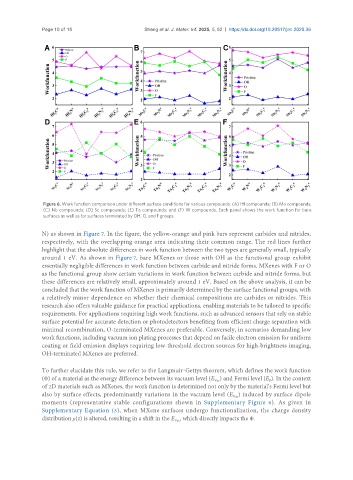
                Figure 6. Work function comparison under different surface conditions for various compounds. (A) Hf compounds; (B) Mo compounds;
                (C) Nb compounds; (D) Sc compounds; (E) Ta compounds; and (F) W compounds. Each panel shows the work function for bare
                surfaces as well as for surfaces terminated by OH, O, and F groups.

               N) as shown in Figure 7. In the figure, the yellow-orange and pink bars represent carbides and nitrides,
               respectively, with the overlapping orange area indicating their common range. The red lines further
               highlight that the absolute differences in work function between the two types are generally small, typically
               around 1 eV. As shown in Figure 7, bare MXenes or those with OH as the functional group exhibit
               essentially negligible differences in work function between carbide and nitride forms. MXenes with F or O
               as the functional group show certain variations in work function between carbide and nitride forms, but
               these differences are relatively small, approximately around 1 eV. Based on the above analysis, it can be
               concluded that the work function of MXenes is primarily determined by the surface functional groups, with
               a relatively minor dependence on whether their chemical compositions are carbides or nitrides. This
               research also offers valuable guidance for practical applications, enabling materials to be tailored to specific
               requirements. For applications requiring high work functions, such as advanced sensors that rely on stable
               surface potential for accurate detection or photodetectors benefiting from efficient charge separation with
               minimal recombination, O-terminated MXenes are preferable. Conversely, in scenarios demanding low
               work functions, including vacuum ion plating processes that depend on facile electron emission for uniform
               coating or field emission displays requiring low-threshold electron sources for high-brightness imaging,
               OH-terminated MXenes are preferred.

               To further elucidate this rule, we refer to the Langmuir-Gettys theorem, which defines the work function
               (Φ) of a material as the energy difference between its vacuum level (E ) and Fermi level (E ). In the context
                                                                         Vac
                                                                                            F
               of 2D materials such as MXenes, the work function is determined not only by the material’s Fermi level but
               also by surface effects, predominantly variations in the vacuum level (E ) induced by surface dipole
                                                                                Vac
               moments  (representative  stable  configurations  shown  in  Supplementary  Figure  6).  As  given  in
               Supplementary Equation (3), when MXene surfaces undergo functionalization, the charge density
               distribution ρ(z) is altered, resulting in a shift in the E , which directly impacts the Φ.
                                                            Vac

