


Page 119 - Read Online
P. 119
Page 12 of 15                      Shang et al. J. Mater. Inf. 2025, 5, 52  https://dx.doi.org/10.20517/jmi.2025.36

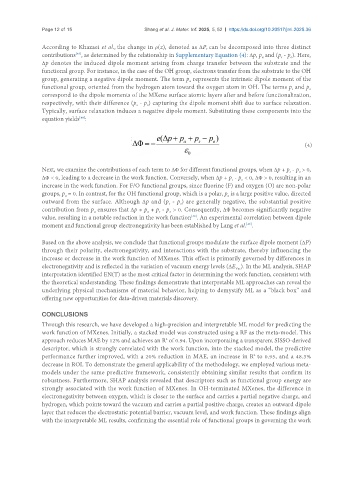
               According to Khazaei et al., the change in ρ(z), denoted as ΔP, can be decomposed into three distinct
                           [48]
               contributions , as determined by the relationship in Supplementary Equation (4): Δp, p  and (p  - p ). Here,
                                                                                                   o
                                                                                                s
                                                                                         a
               Δp denotes the induced dipole moment arising from charge transfer between the substrate and the
               functional group. For instance, in the case of the OH group, electrons transfer from the substrate to the OH
               group, generating a negative dipole moment. The term p  represents the intrinsic dipole moment of the
                                                                 a
               functional group, oriented from the hydrogen atom toward the oxygen atom in OH. The terms p  and p
                                                                                                         o
                                                                                                   s
               correspond to the dipole moments of the MXene surface atomic layers after and before functionalization,
               respectively, with their difference (p  - p ) capturing the dipole moment shift due to surface relaxation.
                                               s
                                                   o
               Typically, surface relaxation induces a negative dipole moment. Substituting these components into the
               equation yields :
                            [48]
                                                                                                        (4)


               Next, we examine the contributions of each term to ΔΦ for different functional groups, when Δp + p  - p  > 0,
                                                                                                   s
                                                                                                      o
               ΔΦ < 0, leading to a decrease in the work function. Conversely, when Δp + p  - p  < 0, ΔΦ > 0, resulting in an
                                                                               s
                                                                                  o
               increase in the work function. For F/O functional groups, since fluorine (F) and oxygen (O) are non-polar
               groups, p  = 0. In contrast, for the OH functional group, which is a polar, p  is a large positive value, directed
                                                                              a
                       a
               outward from the surface. Although Δp and (p  - p ) are generally negative, the substantial positive
                                                          s
                                                              o
               contribution from p  ensures that Δp + p  + p  - p  > 0. Consequently, ΔΦ becomes significantly negative
                                                       s
                                                   a
                                 a
                                                          o
               value, resulting in a notable reduction in the work function . An experimental correlation between dipole
                                                                 [48]
               moment and functional group electronegativity has been established by Lang et al. .
                                                                                    [49]
               Based on the above analysis, we conclude that functional groups modulate the surface dipole moment (ΔP)
               through their polarity, electronegativity, and interactions with the substrate, thereby influencing the
               increase or decrease in the work function of MXenes. This effect is primarily governed by differences in
               electronegativity and is reflected in the variation of vacuum energy levels (ΔE ). In the ML analysis, SHAP
                                                                                Vac
               interpretation identified EN(T) as the most critical factor in determining the work function, consistent with
               the theoretical understanding. These findings demonstrate that interpretable ML approaches can reveal the
               underlying physical mechanisms of material behavior, helping to demystify ML as a “black box” and
               offering new opportunities for data-driven materials discovery.
               CONCLUSIONS
               Through this research, we have developed a high-precision and interpretable ML model for predicting the
               work function of MXenes. Initially, a stacked model was constructed using a RF as the meta-model. This
               approach reduces MAE by 12% and achieves an R  of 0.94. Upon incorporating a transparent SISSO-derived
                                                         2
               descriptor, which is strongly correlated with the work function, into the stacked model, the predictive
               performance further improved, with a 20% reduction in MAE, an increase in R  to 0.95, and a 48.3%
                                                                                       2
               decrease in ROI. To demonstrate the general applicability of the methodology, we employed various meta-
               models under the same predictive framework, consistently obtaining similar results that confirm its
               robustness. Furthermore, SHAP analysis revealed that descriptors such as functional group energy are
               strongly associated with the work function of MXenes. In OH-terminated MXenes, the difference in
               electronegativity between oxygen, which is closer to the surface and carries a partial negative charge, and
               hydrogen, which points toward the vacuum and carries a partial positive charge, creates an outward dipole
               layer that reduces the electrostatic potential barrier, vacuum level, and work function. These findings align
               with the interpretable ML results, confirming the essential role of functional groups in governing the work

