


Page 30 - Read Online
P. 30
Greene et al. J Environ Expo Assess 2024;3:12  https://dx.doi.org/10.20517/jeea.2024.09  Page 7 of 15

               Breastmilk transfer
               Study data for calculating the breastmilk transfer factor are limited and few additional studies containing
               both maternal serum and corresponding breastmilk concentrations have been published since 2017. This is
               a key parameter for estimating exposure in breastfed infants and remains a critical data gap. The overall
               mean of mean values from seven studies, 0.046, was calculated and initially used in validation testing
               [Supplementary Table 2]. However, the use of this overall mean value (0.046) was found to consistently
               underestimate measured serum concentrations. To address this, two other options were considered during
               model validation: (1) a mean of the four studies in which maternal serum and milk samples were collected
               within a similar timeframe of each other (0.056); and (2) a one-tailed 95 percent upper confidence limit
               (95UCL) on the mean of the seven studies (0.068). For more information, see the validation section below.


               Volume of distribution
               MDH’s original (2017) model used a volume of distribution (V ) of 0.17 L/kg from US EPA , based on
                                                                                               [26]
                                                                      d
               Thompson et al., and a half-life of 2.3 years . This value was consistent with the volume of extracellular
                                                     [27]
               water in the body. To account for higher water content in the body during early life stages, MDH applied
                                                                                 [28]
               extracellular water V  adjustment factors (V AFs) from birth to 10 years of age . A more recent evaluation
                                 d
                                                    d
               suggests that this V  is too small. In its Public Health Goal for PFOA, California EPA (2024) calculated a
                                d
               clearance rate (CR) for PFOA of 0.00028 L/kg/day based on a regression analysis of reported serum levels
                                                                                   [29]
               and estimated exposures in communities with contaminated drinking water . This regression-based
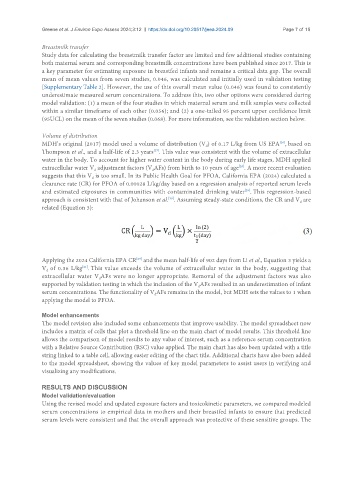
               approach is consistent with that of Johanson et al. . Assuming steady-state conditions, the CR and V  are
                                                          [30]
                                                                                                      d
               related (Equation 3):


               Applying the 2024 California EPA CR  and the mean half-life of 902 days from Li et al., Equation 3 yields a
                                               [29]
               V  of 0.36 L/kg . This value exceeds the volume of extracellular water in the body, suggesting that
                             [21]
                 d
               extracellular water V AFs were no longer appropriate. Removal of the adjustment factors was also
                                  d
               supported by validation testing in which the inclusion of the V AFs resulted in an underestimation of infant
                                                                    d
               serum concentrations. The functionality of V AFs remains in the model, but MDH sets the values to 1 when
                                                     d
               applying the model to PFOA.
               Model enhancements
               The model revision also included some enhancements that improve usability. The model spreadsheet now
               includes a matrix of cells that plot a threshold line on the main chart of model results. This threshold line
               allows the comparison of model results to any value of interest, such as a reference serum concentration
               with a Relative Source Contribution (RSC) value applied. The main chart has also been updated with a title
               string linked to a table cell, allowing easier editing of the chart title. Additional charts have also been added
               to the model spreadsheet, showing the values of key model parameters to assist users in verifying and
               visualizing any modifications.


               RESULTS AND DISCUSSION
               Model validation/evaluation
               Using the revised model and updated exposure factors and toxicokinetic parameters, we compared modeled
               serum concentrations to empirical data in mothers and their breastfed infants to ensure that predicted
               serum levels were consistent and that the overall approach was protective of these sensitive groups. The

