


Page 35 - Read Online
P. 35
Page 12 of 15             Greene et al. J Environ Expo Assess 2024;3:12  https://dx.doi.org/10.20517/jeea.2024.09


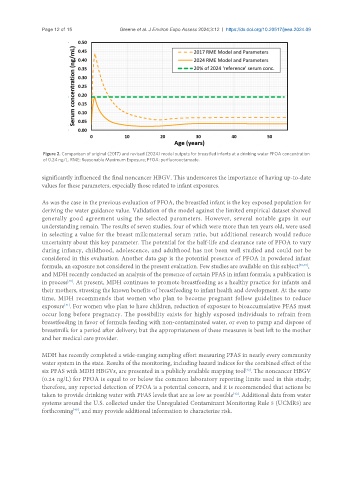
                Figure 2. Comparison of original (2017) and revised (2024) model outputs for breastfed infants at a drinking water PFOA concentration
                of 0.24 ng/L. RME: Reasonable Maximum Exposure; PFOA: perfluorooctanoate.

               significantly influenced the final noncancer HBGV. This underscores the importance of having up-to-date
               values for these parameters, especially those related to infant exposures.


               As was the case in the previous evaluation of PFOA, the breastfed infant is the key exposed population for
               deriving the water guidance value. Validation of the model against the limited empirical dataset showed
               generally good agreement using the selected parameters. However, several notable gaps in our
               understanding remain. The results of seven studies, four of which were more than ten years old, were used
               in selecting a value for the breast milk:maternal serum ratio, but additional research would reduce
               uncertainty about this key parameter. The potential for the half-life and clearance rate of PFOA to vary
               during infancy, childhood, adolescence, and adulthood has not been well studied and could not be
               considered in this evaluation. Another data gap is the potential presence of PFOA in powdered infant
               formula, an exposure not considered in the present evaluation. Few studies are available on this subject [38,39] ,
               and MDH recently conducted an analysis of the presence of certain PFAS in infant formula; a publication is
               in process . At present, MDH continues to promote breastfeeding as a healthy practice for infants and
                        [40]
               their mothers, stressing the known benefits of breastfeeding to infant health and development. At the same
               time, MDH recommends that women who plan to become pregnant follow guidelines to reduce
               exposure . For women who plan to have children, reduction of exposure to bioaccumulative PFAS must
                       [41]
               occur long before pregnancy. The possibility exists for highly exposed individuals to refrain from
               breastfeeding in favor of formula feeding with non-contaminated water, or even to pump and dispose of
               breastmilk for a period after delivery; but the appropriateness of these measures is best left to the mother
               and her medical care provider.


               MDH has recently completed a wide-ranging sampling effort measuring PFAS in nearly every community
               water system in the state. Results of the monitoring, including hazard indices for the combined effect of the
                                                                                    [42]
               six PFAS with MDH HBGVs, are presented in a publicly available mapping tool . The noncancer HBGV
               (0.24 ng/L) for PFOA is equal to or below the common laboratory reporting limits used in this study;
               therefore, any reported detection of PFOA is a potential concern, and it is recommended that actions be
               taken to provide drinking water with PFAS levels that are as low as possible . Additional data from water
                                                                                [42]
               systems around the U.S. collected under the Unregulated Contaminant Monitoring Rule 5 (UCMR5) are
               forthcoming , and may provide additional information to characterize risk.
                          [43]

