


Page 34 - Read Online
P. 34
Greene et al. J Environ Expo Assess 2024;3:12  https://dx.doi.org/10.20517/jeea.2024.09  Page 11 of 15

               Table 4. Changes in modeled peak serum concentration for breastfed infants attributable to non-chemical-related model updates
               and improvements
                                                                      Peak serum concentration* relative to baseline
                Model update
                                                                      (ng/mL)
                2017 Model (baseline)                                 0.438 (n/a)
                Mass-based calculation                                0.342 (-22%)
                Mass-based and maternal loss to newborn               0.313 (-28%)
                Milk Intake smoothing and phase-in                    0.439 (+0.38%)
                Milk Intake smoothing alone                           0.441 (+0.62%)
                Milk Intake phase-in alone                            0.437 (-0.24%)
                Body weight and water intake rate updates (including BW transition for breastfed   0.438 (+0.056%)
                infants at 1 year old)
                All “non-chemical-specific” updates combined          0.318 (-27%)
               *Using a drinking water concentration of 0.24 ng/L.


               Table 5. Changes in modeled peak serum concentration for breastfed infants attributable to chemical parameter changes
                Model parameter update                     Peak serum concentration* relative to baseline, ng/mL
                Revised model with 2017 chemical parameters (baseline)  0.318 [Table 4]
                Half-life                                  0.344 (+8%)
                V  and V AF                                0.148 (-54%)
                     d
                 d
                Infant:maternal serum ratio                0.318 (-0.10%)
                Milk:maternal serum ratio                  0.353 (+11%)
                All updates combined                       0.187 (-41%)**
               *Using a drinking water concentration of 0.24 ng/L; **-41% is the reduction attributable to changes in chemical parameter values. The overall
               change relative to the 2017 baseline value of 0.438 ng/mL using the 2017 model [Table 4] is -57%.


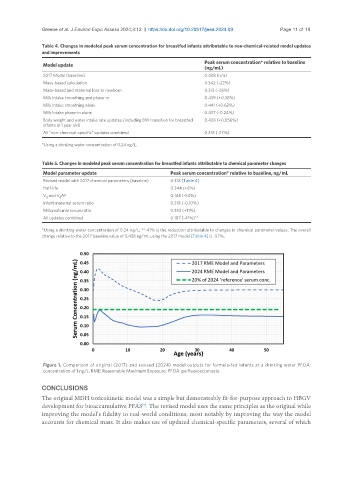
                Figure 1. Comparison of original (2017) and revised (2024) model outputs for formula-fed infants at a drinking water PFOA
                concentration of 1 ng/L. RME: Reasonable Maximum Exposure; PFOA: perfluorooctanoate.

               CONCLUSIONS
               The original MDH toxicokinetic model was a simple but demonstrably fit-for-purpose approach to HBGV
                                                 [9]
               development for bioaccumulative PFAS . The revised model uses the same principles as the original while
               improving the model’s fidelity to real-world conditions, most notably by improving the way the model
               accounts for chemical mass. It also makes use of updated chemical-specific parameters, several of which

