


Page 26 - Read Online
P. 26
Greene et al. J Environ Expo Assess 2024;3:12  https://dx.doi.org/10.20517/jeea.2024.09  Page 3 of 15

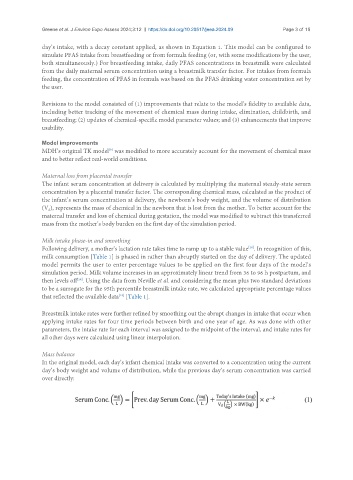
               day’s intake, with a decay constant applied, as shown in Equation 1. This model can be configured to
               simulate PFAS intake from breastfeeding or from formula feeding (or, with some modifications by the user,
               both simultaneously.) For breastfeeding intake, daily PFAS concentrations in breastmilk were calculated
               from the daily maternal serum concentration using a breastmilk transfer factor. For intakes from formula
               feeding, the concentration of PFAS in formula was based on the PFAS drinking water concentration set by
               the user.

               Revisions to the model consisted of (1) improvements that relate to the model’s fidelity to available data,
               including better tracking of the movement of chemical mass during intake, elimination, childbirth, and
               breastfeeding; (2) updates of chemical-specific model parameter values; and (3) enhancements that improve
               usability.


               Model improvements
                                      [9]
               MDH’s original TK model  was modified to more accurately account for the movement of chemical mass
               and to better reflect real-world conditions.

               Maternal loss from placental transfer
               The infant serum concentration at delivery is calculated by multiplying the maternal steady-state serum
               concentration by a placental transfer factor. The corresponding chemical mass, calculated as the product of
               the infant’s serum concentration at delivery, the newborn’s body weight, and the volume of distribution
               (V ), represents the mass of chemical in the newborn that is lost from the mother. To better account for the
                 d
               maternal transfer and loss of chemical during gestation, the model was modified to subtract this transferred
               mass from the mother’s body burden on the first day of the simulation period.


               Milk intake phase-in and smoothing
                                                                                     [18]
               Following delivery, a mother’s lactation rate takes time to ramp up to a stable value . In recognition of this,
               milk consumption [Table 1] is phased in rather than abruptly started on the day of delivery. The updated
               model permits the user to enter percentage values to be applied on the first four days of the model’s
               simulation period. Milk volume increases in an approximately linear trend from 36 to 96 h postpartum, and
                           [18]
               then levels off . Using the data from Neville et al. and considering the mean plus two standard deviations
               to be a surrogate for the 95th percentile breastmilk intake rate, we calculated appropriate percentage values
                                         [18]
               that reflected the available data  [Table 1].
               Breastmilk intake rates were further refined by smoothing out the abrupt changes in intake that occur when
               applying intake rates for four time periods between birth and one year of age. As was done with other
               parameters, the intake rate for each interval was assigned to the midpoint of the interval, and intake rates for
               all other days were calculated using linear interpolation.


               Mass balance
               In the original model, each day’s infant chemical intake was converted to a concentration using the current
               day’s body weight and volume of distribution, while the previous day’s serum concentration was carried
               over directly:

