


Page 215 - Read Online
P. 215
Loh et al. Extracell Vesicles Circ Nucleic Acids 2023;4:568-87  https://dx.doi.org/10.20517/evcna.2023.34                                            Page 576


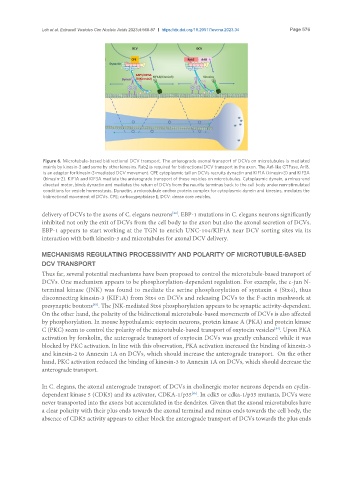
                Figure 6. Microtubule-based bidirectional DCV transport. The anterograde axonal transport of DCVs on microtubules is mediated
                mainly by kinesin-3 and some by other kinesins. Rab2 is required for bidirectional DCV transport in the axon. The Arf-like GTPase, Arl8,
                is an adaptor for kinesin-3-mediated DCV movement. CPE cytoplasmic tail on DCVs recruits dynactin and KIF1A (kinesin-3) and KIF3A
                (kinesin-2). KIF1A and KIF3A mediate the anterograde transport of these vesicles on microtubules. Cytoplasmic dynein, a minus-end
                directed motor, binds dynactin and mediates the return of DCVs from the neurite terminus back to the cell body under non-stimulated
                conditions for vesicle homeostasis. Dynactin, a microtubule anchor protein complex for cytoplasmic dynein and kinesins, mediates the
                bidirectional movement of DCVs. CPE: carboxypeptidase E; DCV: dense core vesicles.

               delivery of DCVs to the axons of C. elegans neurons . EBP-1 mutations in C. elegans neurons significantly
                                                           [82]
               inhibited not only the exit of DCVs from the cell body to the axon but also the axonal secretion of DCVs.
               EBP-1 appears to start working at the TGN to enrich UNC-104/KIF1A near DCV sorting sites via its
               interaction with both kinesin-3 and microtubules for axonal DCV delivery.


               MECHANISMS REGULATING PROCESSIVITY AND POLARITY OF MICROTUBULE-BASED
               DCV TRANSPORT
               Thus far, several potential mechanisms have been proposed to control the microtubule-based transport of
               DCVs. One mechanism appears to be phosphorylation-dependent regulation. For example, the c-jun N-
               terminal kinase (JNK) was found to mediate the serine phosphorylation of syntaxin 4 (Stx4), thus
               disconnecting kinesin-3 (KIF1A) from Stx4 on DCVs and releasing DCVs to the F-actin meshwork at
               presynaptic boutons . The JNK-mediated Stx4 phosphorylation appears to be synaptic activity-dependent.
                                [83]
               On the other hand, the polarity of the bidirectional microtubule-based movements of DCVs is also affected
               by phosphorylation. In mouse hypothalamic oxytocin neurons, protein kinase A (PKA) and protein kinase
               C (PKC) seem to control the polarity of the microtubule-based transport of oxytocin vesicles . Upon PKA
                                                                                              [84]
               activation by forskolin, the anterograde transport of oxytocin DCVs was greatly enhanced while it was
               blocked by PKC activation. In line with this observation, PKA activation increased the binding of kinesin-3
               and kinesin-2 to Annexin 1A on DCVs, which should increase the anterograde transport.  On the other
               hand, PKC activation reduced the binding of kinesin-3 to Annexin 1A on DCVs, which should decrease the
               anterograde transport.

               In C. elegans, the axonal anterograde transport of DCVs in cholinergic motor neurons depends on cyclin-
                                                                  [85]
               dependent kinase 5 (CDK5) and its activator, CDKA-1/p35 . In cdk5 or cdka-1/p35 mutants, DCVs were
               never transported into the axons but accumulated in the dendrites. Given that the axonal microtubules have
               a clear polarity with their plus ends towards the axonal terminal and minus ends towards the cell body, the
               absence of CDK5 activity appears to either block the anterograde transport of DCVs towards the plus ends

